
Explore how the blended rate in software industry provides a streamlined approach to project billing.
✓Key Takeaways
In the fast-paced realm of the software industry, the blended rate model emerges as a key pricing strategy. This model involves combining the costs of different skill levels within a team, offering a streamlined approach to project billing. In this article, we uncover the essentials of blended rates: defining the concept, exploring calculation methods, and highlighting its significance in software development economics.
Key Summary
Overview: This article explains the blended rate model in the software industry, a pricing approach used by development firms to simplify billing and give clients cost transparency.
- Definition: A single, averaged hourly rate applied to a project, combining the rates of different team members (developers, designers, QA) regardless of individual seniority.
- How it works: Instead of billing a senior developer at $100/hour and a junior developer at $50/hour separately, a blended rate (e.g., $75/hour) simplifies billing for the whole team.
- Common in outsourcing: Widely used in offshore and nearshore development, especially in Vietnam, to give clients predictable costs.
- Calculation: Derived by weighting each team member's rate by their share of the workload.
Use cases: Startups outsourcing development for predictable budgets · enterprises managing complex teams · agile projects where team composition changes frequently.
Benefits: Simplifies budgeting and invoicing · gives clients cost predictability · lets teams reallocate skills without renegotiating billing.
Challenges: Can obscure individual contributor value · offers less line-item transparency · requires accurate upfront scoping to avoid misaligned expectations.
Definition and Concept
A blended rate is the average cost calculated across team members with varying skill levels and pay rates who work together on a software project. Rather than charging a separate rate for each team member, the blended rate creates a single, unified hourly rate that represents the collective cost of the entire team's services.
Related reading: 3 Unpredictable Factors You Should Know Before Hiring an Offshore Team
1. What Is the Blended Rate in the Software Industry?
Software projects typically require a team with diverse skills: developers, designers, project managers, QA engineers, and other roles, working together to deliver a solution that meets a client's requirements. This is where the blended rate comes in.
Think of it as finding the average cost of a team's skills. Some team members have more experience, others less. Instead of billing each person separately, the blended rate combines all those costs and finds the middle ground.
2. How to Calculate the Blended Rate
Blended Rate = Σ (Workload % × Hourly Rate) for each team member.
For example, a senior developer billed at $50/hour covers 60% of the workload, and a junior developer billed at $30/hour covers the remaining 40%:
Blended Rate = (0.60 × $50) + (0.40 × $30) = $42/hour
So the blended rate in this example is $42 per hour, the average price of the team's combined services, weighted by how much of the work each role actually contributes.
Related reading: Understanding Hybrid Project Management Model
Custom software development costs vary dramatically depending on where you outsource, whether you already have an in-house team and only need to fill gaps, or whether you're delegating the entire build. Critically, it also depends on the seniority mix of the developers assigned to your project.
When comparing outsourcing markets or providers, buyers typically compare the blended hourly rate of a 6–8 person scrum team, assuming full-time engagement for 12+ months. Actual rates vary by skill level, technical specialty, and the engagement's term and commitment. Engagements are usually structured one of three ways, from most to least preferred:
Option 1: Dedicated Team
The partner commits individuals to you full-time, billed monthly. Developers function as part of your team, sit together (virtually or on-site), and integrate fully into your development process, building the strongest rapport and sense of ownership.
See how InApps structures Dedicated Team engagements →
Option 2: Staff Augmentation
You hire engineers to augment your existing team, billed hourly. Useful for temporary or specialized needs, but requires closer oversight, tracking and approving hours and working harder to keep engineers engaged, since they don't feel the same connection to your team.
Learn more about Staff Augmentation at InApps →
Option 3: Fixed Bid
You hand the partner a detailed spec, and they commit to delivering it for a fixed price. Works well for smaller, tightly scoped projects (e.g., an MVP or a single mobile app) but fits poorly with agile development, where scope evolves as the project progresses.
3. Tips to Keep Your Blended Costs Balanced
When choosing an outsourcing partner, providers bid based on your specifications, scope, workload, and coverage (scope vs. time). Your in-house project management team is responsible for defining that scope and managing the engagement against it.
If you don't provide a clear explanation of your needs upfront, expect additional fees at delivery. That's why it's critical to continuously evaluate and validate project scope, and keep communication, escalation paths, and reporting consistent with your provider.
Related reading: How to Find a Dedicated Software Development Center in Vietnam
You can also set an upper cost cap to prevent uncontrolled overruns, a simple constraint that keeps the project within budget.
Overall, the blended rate model lets service providers offset the cost of specialized skills by blending them with lower-cost resources, producing a more balanced, predictable cost structure for the client.
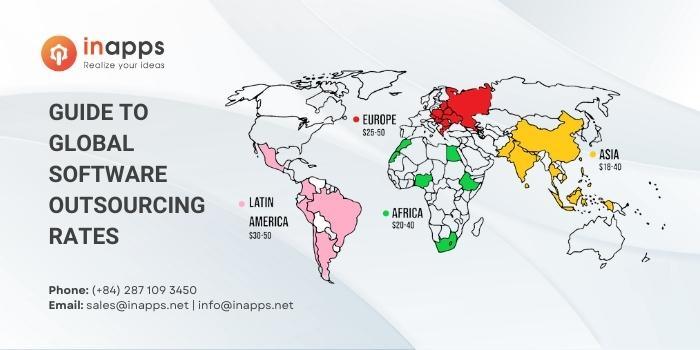
4. Global Software Development Outsourcing Rates
Outsourcing rates vary significantly by geography, talent level, expertise, technology stack, and commitment length. Location (nearshore vs. offshore) is one of the biggest drivers of rate differences:
- Nearshore partners share a similar time zone (for a US company, this typically means Canada or Latin America), enabling real-time collaboration and easier on-site visits.
- Offshore teams in Asia or Eastern Europe typically offer the largest cost savings, with the trade-off of larger time-zone gaps and cultural differences to manage.
Editorial note: rate benchmarks should be sourced from a current (2026) industry report before publishing, the previous version cited a 2023 Accelerance dataset, which is now stale for a pricing-focused page and should be replaced or clearly dated.
See the latest Offshore Software Development Rates by Country →
The Bottom Line
The software outsourcing industry is highly competitive and only getting more diverse. The blended rate model gives you the flexibility to allocate team members with different skill levels across a project without destabilizing the overall cost, provided the scope is well defined upfront.
Before you outsource, evaluate potential partners on specialty, track record, hiring process, communication practices, and total cost-benefit, not rate alone.
Related Articles

Best Countries to Outsource Software Development (2026 Guide)
Software development outsourcing means hiring an external engineering team - usually based in another country- to design, build, or maintain software on your behalf, instead of hiring in-house. Most US, UK, and Australian companies do this to access skilled engineers faster and at a lower fully-loaded cost than domestic hiring allows.

How to Hire Remote Developers Without Losing Code Quality: A 2026 Playbook for CTOs
Every CTO who hires remote developers eventually asks the same question: how do I know this is going to work before I've sunk three months and a sprint's worth of technical debt into finding out? Most guides to hiring remote developers answer a different question: which platform to use. They skip the part that actually determines whether the code that comes back is any good. This playbook covers the vetting mechanics, engagement models, and real rate data behind hiring remote engineers who ship production-quality code from week one, not another list of freelance marketplaces.
IT Managed Services vs Break-Fix IT Support: What Growing Startups Need in 2026
Break-fix IT feels free right up until the week something breaks in production and there is no one already watching for it. Here is how growing startups actually decide between break-fix support and managed services in 2026, and why the decision has gotten sharper for anyone shipping a product built quickly with AI tools.