
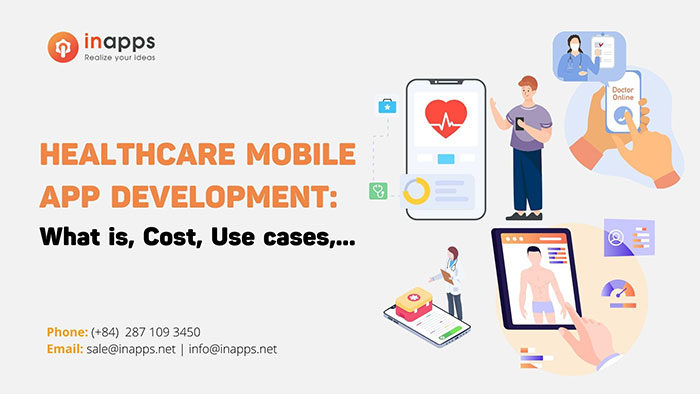
Healthcare app development comes with a compliance checklist most explainers skip and a cost range that's usually vaguer than it needs to be. This guide breaks down what these apps actually do, what they cost by scope, the regulations you can't work around, and how to pick a development partner who has actually shipped one.
✓Key Takeaways
Quick answer: Healthcare app development typically runs from $15,000 for a narrow MVP to $100,000+ for a full multi-feature platform, with cost driven mainly by compliance scope (HIPAA, GDPR) and integrations (EHR, telemedicine, payments) rather than visual design. A health app and a medical app are legally distinct: medical apps that interact with regulated devices or clinical decisions carry regulatory exposure a general wellness app doesn't. Any partner claiming "HIPAA compliant" should be willing to sign a Business Associate Agreement, not just say the phrase.
What Is Healthcare App Development?
Healthcare app development is the process of building mobile or web applications that let patients, doctors, and administrative staff manage health information, communicate, and handle clinical or operational tasks in real time. That covers a wide range of things: appointment booking, electronic health records (EHR), telemedicine consultations, remote monitoring, and insurance or billing workflows.
Two groups use these apps for different reasons:
- For doctors and staff: patient monitoring, appointment scheduling, staff management, and administrative reporting.
- For patients: booking appointments, messaging their care team, tracking symptoms or biomarkers, and receiving care recommendations.
The category is broader than most buyers expect going in. A hospital's internal staff-scheduling tool, a patient-facing symptom tracker, and a pharmacy chain's ecommerce and inventory platform are all "healthcare app development" in the sense that matters for scoping a project: they all touch sensitive operational or personal data and need to keep running without downtime. The specific compliance and integration requirements differ sharply between them, which is exactly why a single flat quote for "a healthcare app" is a sign a partner hasn't actually scoped your project yet.
What Is the Difference Between a Health App and a Medical App?
This distinction matters more than most explainers suggest, because it changes your regulatory exposure.
A health app provides general wellness services, such as fitness tracking, meditation, or nutrition logging, and typically isn't regulated as a medical device. A medical app interacts with regulated medical devices, clinical diagnosis, or treatment decisions, which can bring it under FDA (US) or equivalent medical device regulation elsewhere.
A simple way to test which side of the line your idea falls on: if the app's output could plausibly change a clinical decision a doctor makes, or if it connects directly to a regulated device (an insulin pump, a diagnostic sensor), it's almost certainly a medical app. If it's tracking, reminding, or scheduling around health without making a clinical claim, it's usually a health app.
Why this matters for cost: a medical app usually needs a compliance and QA budget a health app doesn't, including validation testing, clinical risk documentation, and in some cases a formal regulatory submission. Scope this correctly before you get a quote, or the first real quote you get will look nothing like your budget.
What Types of Healthcare Apps Are There?
Healthcare apps generally split into two categories by who they're built for:
Professional solutions, built for doctors and clinical staff, supporting patient monitoring, staff coordination, and administrative work.
Patient-facing applications, built for health management, appointment booking, and sharing health data with a care team via smartphone or wearable sensors.
Most real projects end up needing both sides eventually, even if the first release only covers one. A patient-facing appointment app is much less useful without a staff-facing calendar it actually writes to. It's worth planning for both from the architecture stage even if the initial launch scope is narrower.
Use Cases for a Healthcare App
Telehealth & Telemedicine. Connects doctors and patients remotely for consultations. Demand for this surged during COVID-19 and has stayed structurally higher since. Requires reliable video/audio infrastructure and, depending on jurisdiction, specific telehealth compliance.
Electronic Health Records (EHR/EMR). Centralizes patient data on one platform, reducing manual errors and enabling data exchange between providers. Usually the most integration-heavy piece of a healthcare app, because it has to talk to a hospital's or clinic's existing systems.
Health Information Exchange (HIE). Captures vital signs (temperature, blood pressure, heart rate) via smartphone sensors for faster diagnosis, and lets that data move between systems quickly.
Built-in Diagnostic Systems. Pulls data from embedded or IoT devices integrated with EHR platforms so clinicians can visualize and track a patient's condition remotely.
E-Prescribing (eRx). Creates, stores, and sends prescriptions digitally, cutting transcription errors and saving time for both prescriber and patient.
Revenue Cycle Management (RCM) & Medical Billing. Handles billing, claims, and practice management in one system, so patients and staff aren't switching between separate tools for records and payments.
How Much Does It Cost to Develop a Healthcare App?
Cost depends far more on compliance scope and integrations than on how polished the UI looks. Two apps with similar screens can cost very differently once you factor in whether one needs EHR integration and HIPAA-grade data handling and the other doesn't.
| Tier | Scope | Typical Cost Range | Team |
|---|---|---|---|
| MVP | Core features only: profile, appointment booking, basic messaging, no deep EHR integration | $15,000 – $30,000 | 1 PM, 0.5 UX/UI, 2 developers, 1 QA |
| Mid-complexity | MVP scope plus EHR/telemedicine integration, payment processing, HIPAA-grade compliance work | $30,000 – $100,000 | 1 PM, 1 UX/UI, 3-4 developers, 1 QA, 1 DevOps |
| Full platform | Multi-role platform (patient + provider + admin), advanced integrations, IoT/wearables, multi-region compliance | $100,000+ | 1 senior PM, 1 UX/UI, 5-7 developers, 2 QA, 1-2 DevOps |
(Ranges based on InApps' own project-based engagement tiers. Ask for a scoped quote against your actual feature list rather than treating these as fixed prices.)
What actually drives cost within a tier:
- Integrations: EHR/EMR, e-prescribing, insurance/payment systems, and wearable device APIs each add real integration and testing time, not just a checkbox.
- Compliance scope: a medical app with FDA-adjacent exposure costs more to build and QA than a wellness-tracking health app, because of validation and documentation overhead.
- Data security architecture: encryption, audit logging, and role-based access aren't optional add-ons in healthcare. Budgeting for them from the start is cheaper than retrofitting them after a client's security review flags gaps.
How companies typically staff this work:
- In-house team: full control and continuity, but expensive to build and keep staffed (roughly $100-200/hour in the US/EU for comparable seniority), and slow to assemble from zero.
- Freelancers: lower cost per hour, but consistency and continuity are the tradeoff. Healthcare compliance work in particular suffers when there's no single team accountable for the whole build.
- Dedicated offshore team: sustained execution capacity at a materially lower blended rate. InApps' own rate card runs $17-25/hour depending on role (mid to senior developers, QA, DevOps), below the ~$40/hour commonly cited for other offshore hubs. This comes with a dedicated team model (one team works exclusively for one client, IP fully owned by the client, every engineer approved by the client before joining) rather than a shared freelancer pool.
How to Develop a Healthcare App
Step 1: Idea Validation. Define the specific problem you're solving (e.g., medication adherence for a chronic condition) and confirm there's real demand before writing a line of code.
Step 2: Market Research. Talk to the actual users, patients or providers, who'd use this daily. Healthcare workflows have enough regulatory and operational nuance that assumptions from a different industry usually don't transfer cleanly.
Step 3: Business Hypothesis Validation. Test the core assumption with a prototype or clickable mockup before committing full development budget.
Step 4: Build an MVP. Ship the smallest version that proves the core workflow (profile, one integration, one clear use case) rather than every feature on the wishlist.
Step 5: Design Process. UI/UX in healthcare has a lower error tolerance than most consumer apps: a confusing appointment-booking flow or an ambiguous medication reminder has real consequences. Accessibility and clarity matter more here than visual flourish.
Compliance: What You Can't Skip, By Region
| Region | Key Regulation(s) | What It Requires |
|---|---|---|
| United States | HIPAA, HITECH Act, CCPA | Patient data privacy safeguards, breach notification rules, and (for California users) consumer data rights |
| Canada | PIPEDA (federal), provincial health privacy laws | Federal baseline plus province-specific rules depending on where the app operates |
| United Kingdom | UK GDPR, Data Protection Act 2018 | EU-equivalent data protection standards adapted for post-Brexit UK law |
| European Union | GDPR, plus national health-data rules | Strict consent and data-portability requirements; several member states add sector-specific health-data rules on top |
Naming the right law is the easy part. The harder, more useful question is what these laws actually require a development team to do. That's where most "HIPAA compliant" claims fall apart under scrutiny.
What "HIPAA-Compliant Development" Actually Requires
Most healthcare app guides stop at naming HIPAA. Here's what it actually obligates a development team to build and sign, in practice:
A signed Business Associate Agreement (BAA). Under HIPAA, any vendor that creates, receives, maintains, or transmits protected health information (PHI) on behalf of a covered entity is a "business associate" and is legally required to sign a BAA before touching that data, with no exceptions for "we're just the developer." If a development partner is reluctant to sign one, or doesn't know what it is, that's disqualifying on its own, regardless of how confidently they used the word "HIPAA" in the sales call.
Encryption at rest and in transit. PHI needs to be encrypted both while stored (typically AES-256) and while moving between systems (TLS 1.2 or higher). This isn't a nice-to-have configuration flag. It needs to be part of the architecture from the first data model, not a setting toggled on before launch.
Access control and audit logging. Every read or write to PHI needs to be tied to an authenticated, authorized user, with role-based access limiting who can see what. Just as important, every access needs to be logged (who viewed what record, and when), because audit logs are what actually let an organization detect and prove the scope of a breach if one happens.
Data minimization, including in non-production environments. Real PHI has no business sitting in a staging or development environment for testing. De-identified or synthetic data should stand in for real patient data anywhere outside the actual production system, a surprisingly common gap, since it's easy to just clone the production database "temporarily" for QA and never migrate off it.
Breach notification readiness. HIPAA requires covered entities to notify affected individuals within 60 days of discovering a breach involving unsecured PHI. A development partner should be able to explain how their systems would detect a breach in the first place. Logging and monitoring are what make that notification clock even startable.
Cloud infrastructure BAAs. If the app runs on AWS, GCP, or Azure, a BAA needs to exist with the cloud provider too, and only their HIPAA-eligible services should be used to store or process PHI, since not every service each provider offers qualifies by default.
None of this is exotic. It's the actual checklist behind the phrase "HIPAA compliant," and any development partner should be able to walk through it specifically rather than reciting the name of the law and moving on.
Key Features to Prioritize
Profile Creation. Account setup with health biomarkers, kept simple enough that patients actually complete onboarding.
File Storage (EHR). Secure storage for prescriptions, lab results, imaging, and records. This is usually the feature most tightly coupled to compliance requirements.
Geo-Location. Helps patients find doctors, labs, or pharmacies nearby, typically via Google Maps (Android) or Apple Maps (iOS) integration.
Appointments. Scheduling synced to a provider's real calendar, not a standalone booking form that creates double-booking risk.
Communication. In-app chat or video conferencing for telemedicine, usually via a dedicated API rather than a bolted-on generic video SDK, since call quality and reliability matter clinically.
Payments. Handles consultation fees, prescriptions, and lab test payments. This needs the same security rigor as the rest of the app, since payment and health data often sit in the same user session.
Red Flags When Evaluating a Healthcare App Development Partner
Most guidance on picking a partner stops at "look for HIPAA experience," which by itself is close to meaningless. These are the signals worth actually screening for:
They say "HIPAA compliant" but hesitate on a BAA. If a partner talks confidently about compliance but gets vague or slow when you ask them to sign a Business Associate Agreement, treat that as the real answer: the sales conversation and the legal commitment don't match.
Every case study is generic. "We helped a healthcare client improve their app" with no name, no number, and no specifics isn't evidence of anything. It's a template. A partner with real delivery experience can point to something concrete, even in an adjacent domain, with an actual result attached.
The quote doesn't move with compliance scope. If a partner gives you the same flat hourly rate whether you need a simple wellness tracker or a full EHR-integrated platform, they likely haven't actually scoped the compliance and integration work, or aren't pricing it in, which shows up later as scope creep.
They lead with the cheapest option before asking about your data. A partner who steers straight to "let's use freelancers, it's cheaper" without first asking what kind of data your app will touch is optimizing for closing the deal, not for your actual risk profile.
No clear answer for engineer continuity. Ask what happens if the engineer working on your project leaves mid-build. A partner without a real answer (a documented handoff process, a bench of vetted engineers, a replacement guarantee) is asking you to bet your compliance posture on one person's availability.
Proof, Not Promises: What InApps Has Actually Shipped
Worth stating plainly instead of implying otherwise: InApps does not currently hold a formal HL7 or FHIR interoperability certification. If your project needs deep, certified healthcare-data-interoperability work specifically, ask any partner, InApps included, for that credential directly, not a general "healthcare experience" claim standing in for it.
What the team does have is delivery experience in adjacent regulated, data-sensitive commerce: InApps built a PHP/Laravel ecommerce platform for Trung Son Pharmacy, a multi-location pharmacy retailer, unifying web, mobile, and admin systems with real-time ERP synchronization across stores. The platform hit 99.9% operational uptime within three months of launch, meaning it kept a live, multi-system, real-time-sync commerce platform running reliably for a pharmacy business from day one, not just in a demo environment.
That's a genuinely different skill from generic web development, and it's the same underlying skill that healthcare-adjacent integration work demands: keeping regulated, transactional data flowing correctly between systems without downtime, under real business pressure. It isn't a substitute for a specific FHIR/HL7 certification if that's what your project requires. It is, however, a real, checkable answer to "have you actually shipped something like this," which is a more useful question than "are you HIPAA experts" in the first place.
What Happens After You Contact InApps
1. Discovery call. A scoping conversation covering your feature list, compliance requirements, and timeline, not a generic sales pitch.
2. Proposal. A cost estimate scoped against your actual requirements, following the same logic as the cost tiers above, not a flat "healthcare app" number.
3. Kickoff. The team is assembled and you review and approve every engineer before they start on your project, not after.
4. Development. Agile delivery in 2-week sprints with daily standups, and you communicate directly with the engineers building your product, without a project manager relaying messages in between.
5. Testing, deployment, and ongoing support. QA and security review before launch, followed by a 90-day warranty and optional maintenance tiers for continued support after go-live.
The Bottom Line
Healthcare app development isn't one product with one price. An MVP with basic scheduling and a full multi-role platform with EHR integration and multi-region compliance are different projects with different risk profiles, and the cost difference between them mostly comes from compliance and integration work, not screen count.
If you're early and validating an idea, start with the smallest MVP that proves the core workflow and get compliance architecture right from day one rather than retrofitting it later. If you already know the integrations and regulatory scope you need, get a quote against that specific list rather than a generic "healthcare app" estimate.
Whichever partner you choose, verify the things that are actually checkable: a signed BAA, specific technical controls, a real case study with a real number, and a clear answer for what happens if an engineer leaves mid-project. Certifications and confident language about "HIPAA expertise" are worth far less than any one of those.
Frequently Asked Questions
Related Articles

Best Countries to Outsource Software Development (2026 Guide)
Software development outsourcing means hiring an external engineering team - usually based in another country- to design, build, or maintain software on your behalf, instead of hiring in-house. Most US, UK, and Australian companies do this to access skilled engineers faster and at a lower fully-loaded cost than domestic hiring allows.
How to Hire Remote Developers Without Losing Code Quality: A 2026 Playbook for CTOs
Every CTO who hires remote developers eventually asks the same question: how do I know this is going to work before I've sunk three months and a sprint's worth of technical debt into finding out? Most guides to hiring remote developers answer a different question: which platform to use. They skip the part that actually determines whether the code that comes back is any good. This playbook covers the vetting mechanics, engagement models, and real rate data behind hiring remote engineers who ship production-quality code from week one, not another list of freelance marketplaces.
IT Managed Services vs Break-Fix IT Support: What Growing Startups Need in 2026
Break-fix IT feels free right up until the week something breaks in production and there is no one already watching for it. Here is how growing startups actually decide between break-fix support and managed services in 2026, and why the decision has gotten sharper for anyone shipping a product built quickly with AI tools.