
Discover how offshore AI development center services empower businesses with cost-effective, scalable AI solutions. Leverage global talent and accelerate innovation today!
Navigating the complex world of artificial intelligence (AI) development can be daunting. From recruiting specialized talent to managing project timelines and budgets, companies often struggle to build world‑class AI solutions in-house. That’s where offshore AI development center services come in. By partnering with a dedicated offshore team, organizations can:
- Access top AI talent without local constraints
- Reduce development costs by up to 40%
- Scale resources rapidly to meet dynamic project needs
This guide provides practical insights for both beginners and seasoned leaders on leveraging offshore AI development centers to drive innovation and growth.
What Is an Offshore AI Development Center?
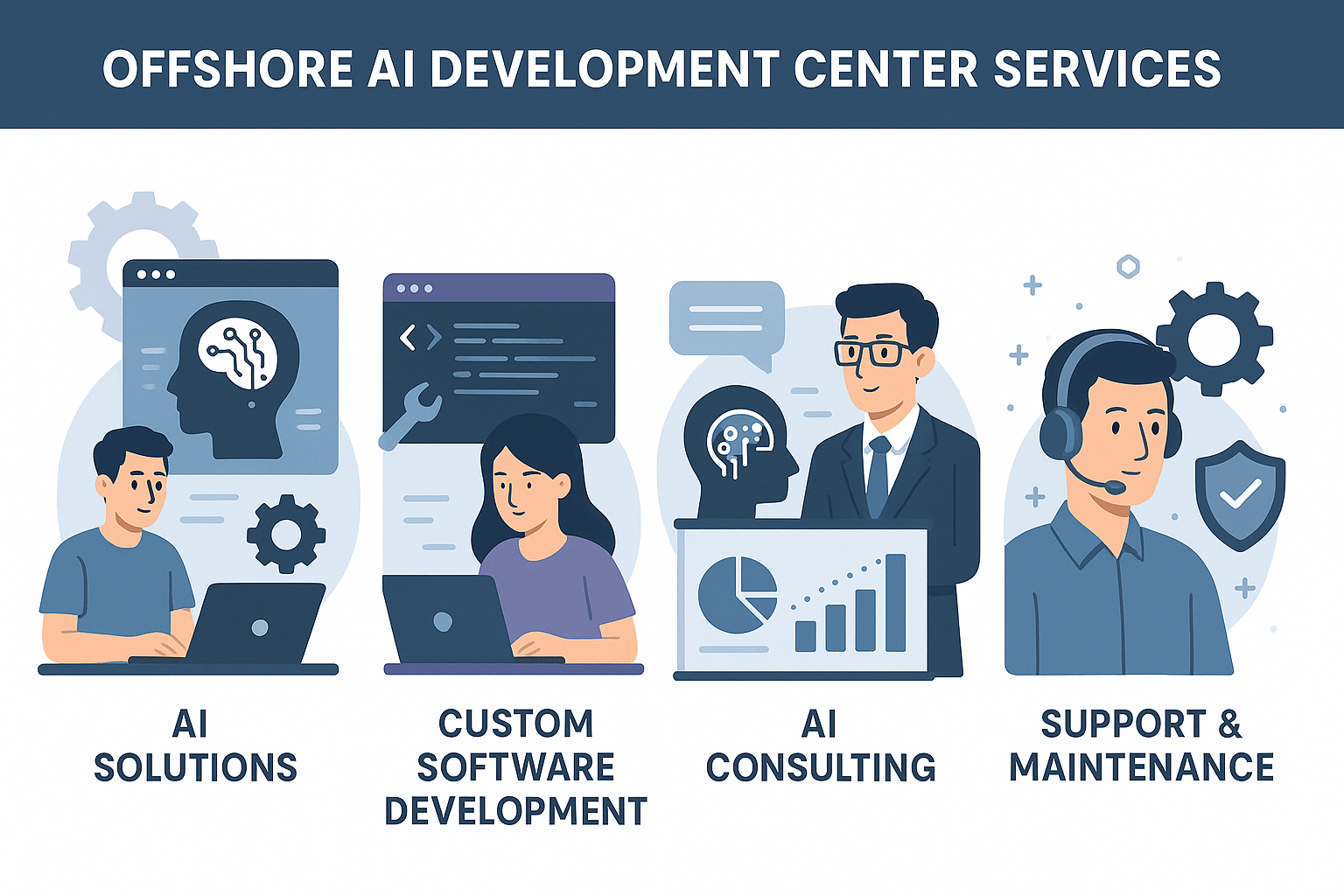
An offshore AI development center (ADC) is a remote facility—often in regions with strong tech talent pools—staffed by AI engineers, data scientists, and project managers who work exclusively on your AI initiatives. Unlike traditional outsourcing, an offshore ADC functions as an extension of your in‑house team, offering:
- Dedicated Teams: Full‑time experts focused solely on your projects.
- Seamless Collaboration: Aligned processes, tools, and reporting structures.
- Long‑Term Partnership: Ongoing optimization, maintenance, and scaling.
Key Benefits of Offshore AI Development Center Services
1. Cost Efficiency
- Lower Labor Costs: Benefit from competitive rates in locations like Vietnam or Eastern Europe.
- Predictable Budgeting: Fixed monthly fees for dedicated teams.
- Reduced Overheads: No need to invest in local office space or equipment.
Read More:
What Is ODC (Offshore Development Center)? Understand Offshore Development Center In 3 Seconds
2. Access to Specialized Talent
- AI Engineers & Data Scientists: Skilled in TensorFlow, PyTorch, and scikit‑learn.
- Domain Expertise: Experience in industries like healthcare, fintech, and e‑commerce.
- Continuous Learning: Teams stay updated on the latest AI research and best practices.
3. Scalability & Flexibility
- Rapid Team Expansion: Scale up or down within weeks to match project demands.
- Flexible Engagement Models: Choose from dedicated teams, staff augmentation, or hybrid approaches.
- 24/7 Development: Leverage time‑zone advantages for round‑the‑clock progress.
4. Accelerated Time to Market
- Parallel Workstreams: Multiple AI modules developed simultaneously.
- Mature Processes: Proven workflows and DevOps pipelines ensure efficiency.
- Risk Mitigation: Early risk identification through robust QA and peer reviews.
How to Choose the Right Offshore AI Development Center
Selecting the ideal partner requires a multidimensional evaluation:
1. Technical Expertise
- Portfolio vetting: Ask for live demos of chatbots, vision systems, or recommendation engines.
- Code deep‑dives: Review Git commits, unit tests, and ML experiment logs to assess rigor.
- Certifications: Check for cloud specialist badges (AWS ML Pro, Google Cloud Professional ML).
2. Communication & Culture Fit
- Language fluency: Guarantee at least B2 English, ideally C1+, to avoid misinterpretations.
- Overlap hours: Ensure 3–4 hours of daily synchronous collaboration.
- Cultural workshops: Brief both teams on holidays, work norms, and feedback styles.
3. Security & Compliance
- Data governance: Onshore vs. offshore data residency mandates.
- Audit trails: SIEM logs, vulnerability scans, and penetration test reports.
- Legal frameworks: NDAs, SLAs with clear IP ownership and exit‑clause terms.
4. Project Management Discipline
- Agile maturity: Certified Scrum Masters, bi‑weekly sprint cadences, and quarterly roadmaps.
- Transparency: Real‑time dashboards, OKR tracking, and stakeholder reviews.
- Quality gates: Automated testing, manual QA, and ML model validation protocols.
5. References & Reputation
- Client interviews: Talk to peers in your industry about on‑the‑ground experiences.
- Independent reviews: Check Clutch, G2, or Gartner Peer Insights for unbiased feedback.
- Longevity: Partners with 5+ years in AI outsourcing demonstrate staying power.
Read More:
Complete Guide To Java Software Outsourcing in Vietnam
Offshore AI Development Center Service Models
Dedicated Team Model
- Structure: A fixed roster of AI professionals embedded with your internal squads.
- Ideal for: Ongoing product development, continuous feature enhancements, and multi‑phase roadmaps.
- Pros: Deep domain knowledge, strong team cohesion, predictable costs.
- Cons: Minimum commitment terms (often 6–12 months).
Staff Augmentation
- Structure: Bolt-on AI experts to fill specific skill gaps—e.g., an NLP researcher for a 3‑month project.
- Ideal for: Short‑term spikes in workload or specialized phases (proof‑of‑concept, model tuning).
- Pros: Maximum flexibility, no long‑term overhead.
- Cons: Less team cohesion; ramp‑up time for each new role.
Project-Based Engagement
- Structure: Full turnkey delivery—requirements gathering, development, deployment, and handover.
- Ideal for: One‑off AI applications with clearly defined scope (e.g., a fraud detection API).
- Pros: Fixed budget, defined deliverables.
- Cons: Change requests may incur additional costs; limited post‑launch support.
Best Practices for Maximizing ROI
- Define Clear Objectives Establish measurable KPIs (e.g., model accuracy, inference latency). Prioritize business use cases: predictive maintenance, customer personalization, fraud detection.
- Establish measurable KPIs (e.g., model accuracy, inference latency).
- Prioritize business use cases: predictive maintenance, customer personalization, fraud detection.
- Adopt Agile & DevOps Implement CI/CD pipelines for rapid iterations. Conduct daily stand‑ups and bi‑weekly retrospectives.
- Implement CI/CD pipelines for rapid iterations.
- Conduct daily stand‑ups and bi‑weekly retrospectives.
- Foster Collaboration Schedule overlapping work hours for real‑time discussions. Use collaborative platforms like Confluence and Miro for documentation and brainstorming.
- Schedule overlapping work hours for real‑time discussions.
- Use collaborative platforms like Confluence and Miro for documentation and brainstorming.
- Invest in Knowledge Transfer Organize regular training sessions and code walk‑throughs. Maintain a shared repository of AI assets and best practices.
- Organize regular training sessions and code walk‑throughs.
- Maintain a shared repository of AI assets and best practices.
- Monitor & Optimize Employ monitoring tools for model drift and performance metrics. Plan for continuous improvement cycles post‑deployment.
- Employ monitoring tools for model drift and performance metrics.
- Plan for continuous improvement cycles post‑deployment.
Common Challenges and Solutions
Challenge | Solution
Time‑zone gap | Schedule “golden hours” overlap; rotate meeting times to share the burden.
Language nuances | Use structured handover notes; leverage translation tools for spec documents.
Quality variance | Standardize code review checklists; automate unit and integration tests.
Data security fears | Encrypt data at rest/in transit; conduct joint security drills and tabletop exercises.
Cultural misalignment | Organize quarterly onsite visits or virtual teambuilding; clarify feedback etiquette.
Read More:
Onshore vs Nearshore vs Offshore Outsourcing Models (+Case studies)
Conclusion & Next Steps
Embracing offshore AI development center services empowers organizations to tap into global expertise, optimize costs, and accelerate AI innovation. By selecting the right partner and following best practices—clear objectives, Agile processes, and strong collaboration—you can transform AI from a buzzword into a competitive advantage.
Ready to scale your AI initiatives?
- Contact our Offshore AI Experts for a free consultation.
- Explore our AI Development Resource Hub for whitepapers, templates, and case studies.
Rate this post
Related Articles
Best Countries to Outsource Software Development (2026 Guide)
Software development outsourcing means hiring an external engineering team - usually based in another country- to design, build, or maintain software on your behalf, instead of hiring in-house. Most US, UK, and Australian companies do this to access skilled engineers faster and at a lower fully-loaded cost than domestic hiring allows.
How to Hire Remote Developers Without Losing Code Quality: A 2026 Playbook for CTOs
Every CTO who hires remote developers eventually asks the same question: how do I know this is going to work before I've sunk three months and a sprint's worth of technical debt into finding out? Most guides to hiring remote developers answer a different question: which platform to use. They skip the part that actually determines whether the code that comes back is any good. This playbook covers the vetting mechanics, engagement models, and real rate data behind hiring remote engineers who ship production-quality code from week one, not another list of freelance marketplaces.
IT Managed Services vs Break-Fix IT Support: What Growing Startups Need in 2026
Break-fix IT feels free right up until the week something breaks in production and there is no one already watching for it. Here is how growing startups actually decide between break-fix support and managed services in 2026, and why the decision has gotten sharper for anyone shipping a product built quickly with AI tools.