
Offshore rates run from $16 to $30 an hour on InApps' own 2026 rate card, and up to $76 an hour for a senior developer in Western Europe. That gap is the whole story: the country with the lowest number on a rate card is rarely the cheapest project once vetting, ramp time, and turnover get counted.
✓Key Takeaways
Offshore rates run from $16 to $30 an hour on InApps' own 2026 rate card, and up to $76 an hour for a senior developer in Western Europe. That gap is the whole story: the country with the lowest number on a rate card is rarely the cheapest project once vetting, ramp time, and turnover get counted.
Quick answer: Offshore software development rates in 2026 span roughly $18-25/hr in South Asia, $16-30/hr in Vietnam depending on role (InApps rate card), $26-65/hr across Eastern Europe, and $64-76/hr for senior developers in Western Europe. Engagement models matter as much as geography: an hourly rate, a monthly dedicated-team rate, and a fixed-scope project price aren't directly comparable units. The single biggest cost driver isn't the country, it's whether the team is vetted for both technical skill and communication before you ever see a CV.
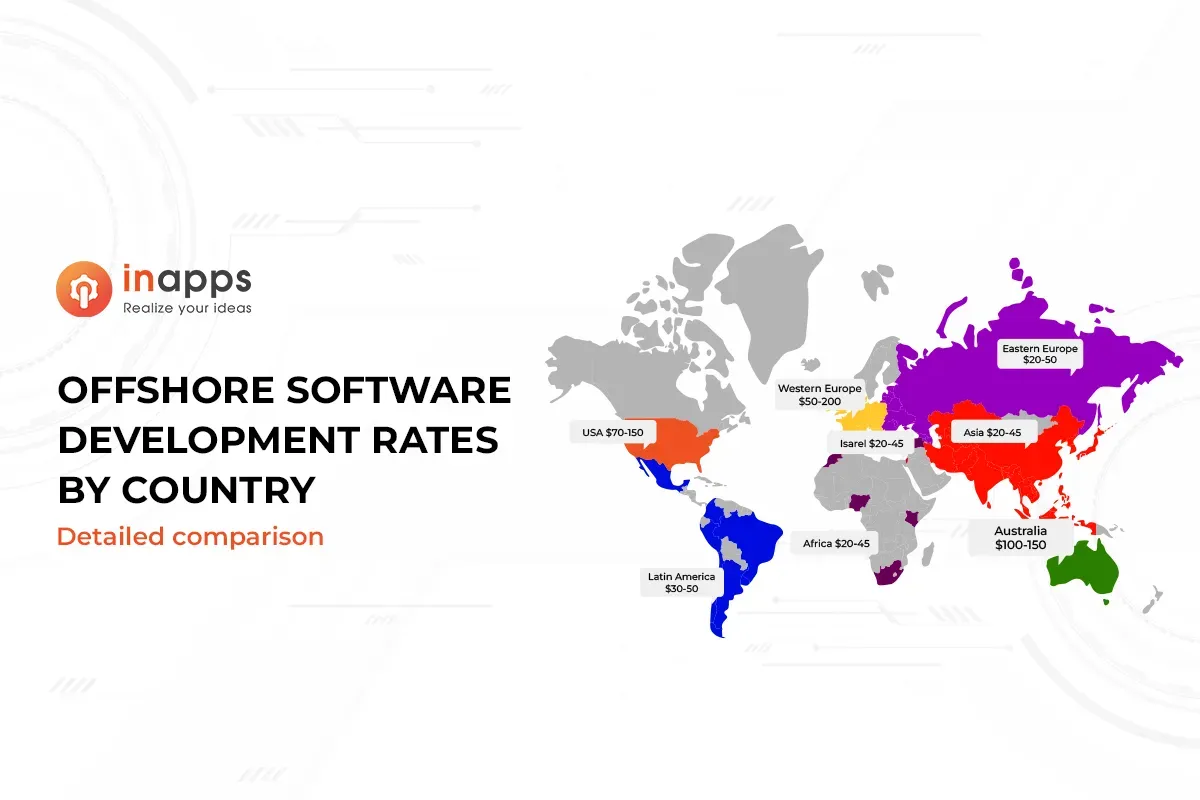
Global Rate Overview 2026
| Region | Rate/hr (2026) | Source |
|---|---|---|
| North America | $50-199/hr, up to $300/hr in CA/NY | Aalpha, 2026 |
| Western Europe | Germany $33-53/hr full-time, $140-200/hr freelance; Netherlands $30-70/hr; Switzerland up to $199/hr | Lemon.io, Qubit Labs |
| Eastern Europe | Ukraine $26-50/hr, Poland $35-80/hr, Romania $45-65/hr | Lemon.io, Alcor |
| Latin America | $18-80/hr depending on country and seniority | Curotec |
| South Asia | $18-25/hr | Accelerance, 2026 |
| Vietnam | $16-30/hr by role, most dev roles $17-22/hr | InApps Rate Card, 2026 (first-party) |
| Philippines | $15-55/hr by seniority | Second Talent |
| China | $25-49/hr, up to $200/hr at top-tier firms | HiredChina |
| Africa | $20-45/hr, up to $99/hr in South Africa/Nigeria | Weetracker, 2026 |
| Israel | ~$34-47/hr (salary-equivalent, not agency billing rate) | CWS Israel, 2026 |
Methodology: ranges blend published 2026 outsourcing rate guides per region with InApps' own published 2026 rate card for Vietnam-based teams. Where sources disagreed by a wide margin, we kept the fuller range instead of picking one number to simplify the story.
What the Hourly Rate Doesn't Tell You
A $20/hr developer who needs 1.5x the hours to ship a feature isn't cheaper than a $28/hr developer who ships it right the first time. Three things move real cost more than the headline rate.
Onboarding and ramp time. A dedicated offshore team is typically fully onboarded in 4-6 weeks, compared with 3-6 months for an equivalent domestic hire. That ramp period still exists, and you pay full rate through it regardless of provider.
Turnover. Markets with thinner senior benches see higher attrition on long-running projects. Every mid-project handoff costs documentation time, context loss, and usually a quality dip for a sprint or two.
Communication overhead. Weak English proficiency or heavy timezone gaps don't show up on a rate card. They show up as slower standups and specs that need re-explaining, which is the most common reason a cheaper engagement ends up costing more than a pricier one with better process.
None of this means the lowest-rate country is always the wrong choice. It means the rate is a starting filter, not the decision itself.
Compare Offshore Software Development Rates by Country
Eastern Europe
Poland alone has roughly 500,000 working developers, the largest pool in Central and Eastern Europe (Alcor). Over 85% of Ukrainian and Polish IT professionals reach upper-intermediate or advanced English (vamasters.com).
Ukraine: $26-50/hr. Mid-level developers run $26-35/hr, seniors $34-44/hr, strong seniors reach $43-50/hr, and AI/ML/Rust specialists command $55-90/hr. Ukraine holds the deepest senior-engineer bench tracked in the Lemon.io network, with full working-hours overlap with Western Europe.
Poland: $35-65/hr broadly, senior developers $55-80/hr (Alcor), the highest rates in Eastern Europe, reflecting the region's largest talent pool and strongest local demand.
Romania: Senior rates $45-65/hr, typically 15-25% below Poland for comparable seniority (Hauer Power). The talent pool runs 200,000-250,000 ICT specialists, with Cluj-Napoca known as the "Silicon Valley of Eastern Europe" (112HUB).
Latin America
The main advantage here is time zone, not just rate. Mexico City, Bogota, and Sao Paulo overlap 4-8 hours with US business hours, enabling real-time standups that Asia and Eastern Europe can't offer (Globental, 2026).
Brazil: Junior $20-28/hr, mid-level $28-35/hr, senior $40-60/hr. The region's largest tech talent pool, at 750,000+ developers (Curotec).
Mexico: Junior $25-35/hr, mid-level $35-45/hr, senior up to $80/hr. Over 560,000 developers, concentrated in Mexico City, Guadalajara, and Monterrey (Curotec).
Argentina: Junior $18-25/hr, mid-level $25-35/hr, senior $35-55/hr (BEON.tech), with strong technical education and cultural ties to Western Europe.
Asia
Vietnam: $16-30/hr on InApps' own rate card, depending on role and seniority, with most standard development roles falling between $17-22/hr. See "Why Companies Choose Vietnam" below.
India: $20-45/hr (Aalpha), the largest talent pool in this comparison. Quality varies more widely here than in most other regions, since no single national body standardizes outsourcing quality, so vetting the specific team matters more than the country average.
Philippines: Junior $15-20/hr, mid-level $22-27/hr, senior $35-55/hr, with AI/full-stack specialists reaching $45-48/hr (Second Talent). Manila and Cebu are the dominant hubs, with strong English proficiency and US/Australia timezone overlap.
China: $25-49/hr on average, up to $200/hr at top-tier firms for specialized work (HiredChina). English proficiency concentrates in hubs like Shanghai and Shenzhen, and cross-border tax withholding and FX controls add friction that other Asian markets don't have.
Africa
Africa's developer base is 4.7 million strong and growing roughly 21% a year, with seven African countries now in the world's top 25 outsourcing destinations (Weetracker, 2026).
South Africa: $25-99/hr, senior talent $35-55/hr, ranked 5th globally, with timezones aligned to Central Europe.
Nigeria: $25-99/hr, ranked 6th globally, with a fast-growing fintech and mobile development scene (Ecofin Agency).
Kenya: English is an official language, giving Kenyan teams some of the strongest English proficiency in the region, ranked 11th globally.
Egypt: Ranked 15th globally, with the government actively scaling the sector: over 240 companies running roughly 270 service centers and 181,000 jobs today, targeting $6B in outsourcing exports by 2026 (Arab Finance).
High-Cost Markets
United States: $50-199/hr in most regions, up to $300/hr in California and New York. A Silicon Valley senior engineer runs $120,000-180,000/yr fully loaded before benefits (Aalpha).
Germany: Mid-level $33-41/hr, senior $45-53/hr full-time loaded; freelance senior contractors bill $140-200/hr (Lemon.io).
Netherlands: $30-70/hr, with a median senior contract rate around $51/hr (Lemon.io).
Switzerland: The most expensive market in Europe, with rates reaching up to $199/hr (Qubit Labs).
Australia: $50-199/hr locally, up to $300/hr for complex work. Most Australian teams offshore at 50-70% savings versus a Sydney/Melbourne hire (Webco Talent).
Israel: Among the highest-paid tech markets globally, at roughly $34-47/hr salary-equivalent cost (CWS Israel), driven by acute scarcity of cybersecurity and AI specialists in Tel Aviv's "Silicon Wadi" cluster.
How to Actually Evaluate a Rate
- Is this an hourly rate or a monthly dedicated-team rate? A monthly rate already accounts for full-time commitment. Comparing it directly to a freelancer's hourly number undercounts the freelancer's non-billable time.
- Who's vetting the engineer, and how? A rate with no named vetting process is a rate with hidden variance.
- What happens if the engineer doesn't work out? A clear replacement policy tells you more about real risk than another 10% off the hourly rate.
Why Companies Choose Vietnam, and InApps Specifically
Vietnam consistently lands in the best rate-to-risk band in Asia, but the rate isn't why companies choose InApps specifically.
Every engineer is verified internally for both technical skill and communication before their CV is ever sent to you. You then get 1-3 interview rounds, including tests or assignments if you want them. Teams are dedicated exclusively to your project, you retain 100% IP ownership, and standard working hours run 08:30-17:30 Vietnam Time or align fully to your timezone. English proficiency across all roles sits at B2-C1.
If someone isn't the right fit: 15-30 days' notice, a qualified replacement within 1-4 weeks, and no charge for any inactive time during the transition.
The rate card holds up against that: $16/hr for QA and UX roles up to $30/hr for AI leads and architects, with most standard development roles at $17-22/hr, quoted all-in with VAT and working equipment included.
Which engagement model fits depends on where you are:
- Ongoing roadmap, want direct control: Dedicated Development Team / ODC
- Need to fill a specific skill gap fast: IT Staff Augmentation
- Defined scope, fixed deliverable: Project-based engagement
InApps holds a 4.9/5 rating across 36 reviews on Clutch and is ISO 27001 certified.
See real engagements in our case studies. Book a free 30-minute call for an exact rate against your scope, not a range.
What Actually Drives the Price
- Local cost of living and income levels: the single biggest driver of the country-to-country gap.
- Skill and tech-stack rarity: AI/ML, blockchain, and niche legacy stacks command a premium regardless of country.
- Experience and delivery track record: a team with a proven history charges for lower risk, not just more skill.
- Scope and engagement model: a dedicated monthly rate, a staff-aug placement, and a fixed-scope project price differently even at the same underlying hourly cost.
The Bottom Line
Every region in this comparison has a real, defensible case: Eastern Europe for senior depth, Latin America for timezone overlap, the Philippines and India for scale, Vietnam for rate-to-risk balance. The country that wins on paper rarely wins on delivery unless the vetting and communication process behind the rate holds up too.
If the project runs longer than a few months and needs consistent ownership, a dedicated monthly rate from a vetted team beats chasing the lowest hourly number across five different countries.
Frequently Asked Questions
Related Articles

What Is an Offshore Development Center (ODC)?
An Offshore Development Center (ODC) is a dedicated engineering team based in a lower-cost country, working full-time and exclusively for one company under its processes, tools, and quality standards. Unlike project outsourcing, an ODC functions as a permanent extension of the in-house team, not a separate vendor delivering against a spec. Companies typically consider an ODC when they need to scale engineering capacity by five or more roles for 12 months or longer.

How to Hire Offshore Python Developers From Vietnam
Python is a popular programming language created by Guido van Rossum and released in 1991. It’s known for its simplicity and readability. Python is used in web development (e.g., with Django),…

Hire Offshore Angular Developers: The Right Development Team In Vietnam
While onshore software development decreases, offshore and nearshore development shows an upward trend, with offshore staying consistent at around 40-45%. There's a reason behind the popularity of…