
What is event driven API? Why should you adopt event driven API? Which event drive API management tool is suitable to use?
Together with InApps learn about React in Real-Time with Event Driven API in today’s post!
Nowadays, more users yarn for interactive experiences. Instead of hitting the refresh button, they expect to be told if having something changed.
Receive notifications when someone likes your post on Instagram or one of your Facebook friends has just updated her/his status are examples of frontend applications reacting to events in the backend
This is made possible through event-driven APIs, which are supported through various modes of asynchronous event-driven communication between the client application and the backend.
So, as developers and architects, how should we handle asynchronous or event-driven communication in the world of APIs where synchronous communication is predominant and most firewalls block non-HTTP traffic?
It’s a matter of having an event-driven backend, choosing an asynchronous web API technology based on your exact async requirements, and a client that can work with remote events.
In this article, you will find helpful information about why even-driven APIs are worth adopting, which Asynchronous API Technology suits your purpose and tools for managing event-driven APIs.
Key Summary
This article from InApps Technology, authored by Phu Nguyen, explores event-driven APIs and their role in enabling real-time, interactive experiences in React applications. It discusses the need for asynchronous communication, suitable technologies, backend architecture, and management strategies to support scalable, push-based interactions. Key points include:
- Why Event-Driven APIs?: Context: Users expect real-time updates (e.g., social media notifications) without manual refreshes, moving away from synchronous, polling-based APIs. Benefits: Push Updates: Servers send changes to clients instantly, eliminating inefficient polling. Two-Way Communication: Supports continuous client-backend interactions. Scalability: Reduces backend load for applications with frequent interactions. System-Wide Monitoring: Tracks events across systems for real-time insights. Use Cases: Applications requiring server-to-client updates. High-interaction scenarios (e.g., live chats, notifications). Systems needing to monitor broad event streams.
- Context: Users expect real-time updates (e.g., social media notifications) without manual refreshes, moving away from synchronous, polling-based APIs.
- Benefits: Push Updates: Servers send changes to clients instantly, eliminating inefficient polling. Two-Way Communication: Supports continuous client-backend interactions. Scalability: Reduces backend load for applications with frequent interactions. System-Wide Monitoring: Tracks events across systems for real-time insights.
- Push Updates: Servers send changes to clients instantly, eliminating inefficient polling.
- Two-Way Communication: Supports continuous client-backend interactions.
- Scalability: Reduces backend load for applications with frequent interactions.
- System-Wide Monitoring: Tracks events across systems for real-time insights.
- Use Cases: Applications requiring server-to-client updates. High-interaction scenarios (e.g., live chats, notifications). Systems needing to monitor broad event streams.
- Applications requiring server-to-client updates.
- High-interaction scenarios (e.g., live chats, notifications).
- Systems needing to monitor broad event streams.
- Choosing Asynchronous API Technologies: WebSockets: Ideal for multiplexed, bidirectional streaming with high message volume (e.g., chat apps). Server-Sent Events (SSE): Best for browser clients subscribing to a one-way data stream (e.g., live feeds). Webhooks: Simple for pushing notifications to a few servers (e.g., event triggers). GraphQL Subscriptions/Live Queries: Offers GraphQL benefits but with a complex implementation and learning curve. gRPC/Kafka: Suited for internal microservices communication, not external APIs. Challenges: Selecting the right protocol, ensuring reliable delivery, and achieving web-scale scalability.
- WebSockets: Ideal for multiplexed, bidirectional streaming with high message volume (e.g., chat apps).
- Server-Sent Events (SSE): Best for browser clients subscribing to a one-way data stream (e.g., live feeds).
- Webhooks: Simple for pushing notifications to a few servers (e.g., event triggers).
- GraphQL Subscriptions/Live Queries: Offers GraphQL benefits but with a complex implementation and learning curve.
- gRPC/Kafka: Suited for internal microservices communication, not external APIs.
- Challenges: Selecting the right protocol, ensuring reliable delivery, and achieving web-scale scalability.
- Backend Architecture for Event-Driven APIs: Components: Event-Driven APIs: Exposed via an API management platform supporting eventing semantics. Message Broker: Acts as an intermediary (e.g., for IoT devices, change data capture (CDC) tools, or microservices) to manage event flow. Microservices: Publish/process state change events, handling errors and persistence. Optimal Setup: A scalable microservices architecture (MSA) supports complex event-driven services, using protocols like Webhooks, WebSockets, SSE, or GraphQL Subscriptions for client connections.
- Components: Event-Driven APIs: Exposed via an API management platform supporting eventing semantics. Message Broker: Acts as an intermediary (e.g., for IoT devices, change data capture (CDC) tools, or microservices) to manage event flow. Microservices: Publish/process state change events, handling errors and persistence.
- Event-Driven APIs: Exposed via an API management platform supporting eventing semantics.
- Message Broker: Acts as an intermediary (e.g., for IoT devices, change data capture (CDC) tools, or microservices) to manage event flow.
- Microservices: Publish/process state change events, handling errors and persistence.
- Optimal Setup: A scalable microservices architecture (MSA) supports complex event-driven services, using protocols like Webhooks, WebSockets, SSE, or GraphQL Subscriptions for client connections.
- Managing Event-Driven APIs: API Management Solutions: Provide governance, access control, monitoring, analytics, and monetization for both asynchronous and REST APIs. AsyncAPI Initiative: An open specification (similar to OpenAPI) for standardizing event-driven APIs, documenting event structure, subscription models, delivery, and security. Support: Many API management tools now support Webhooks and WebSockets, with growing adoption due to AsyncAPI.
- API Management Solutions: Provide governance, access control, monitoring, analytics, and monetization for both asynchronous and REST APIs.
- AsyncAPI Initiative: An open specification (similar to OpenAPI) for standardizing event-driven APIs, documenting event structure, subscription models, delivery, and security.
- Support: Many API management tools now support Webhooks and WebSockets, with growing adoption due to AsyncAPI.
- Conclusion: Synchronous vs. Asynchronous: Synchronous APIs suit instant responses, while event-driven APIs excel for real-time updates or delayed processing. Hybrid Approach: Combining event-driven and request/response designs creates scalable, reactive web applications. Business Value: Integrating traditional API management with event-driven architecture enhances scalability and adoption.
- Synchronous vs. Asynchronous: Synchronous APIs suit instant responses, while event-driven APIs excel for real-time updates or delayed processing.
- Hybrid Approach: Combining event-driven and request/response designs creates scalable, reactive web applications.
- Business Value: Integrating traditional API management with event-driven architecture enhances scalability and adoption.
- InApps Insight: InApps Technology, ranked #1 in Vietnam and #5 in Southeast Asia for software development, leverages event-driven APIs in React projects, using Microsoft’s Power Platform and Azure, with Power Fx for low-code solutions and Azure Durable Functions for scalable, real-time workflows. Integrates Node.js, Vue.js, GraphQL APIs (e.g., Apollo), and Azure to deliver dynamic, user-centric applications, targeting startups and enterprises with Millennial-driven expectations.
- InApps Technology, ranked #1 in Vietnam and #5 in Southeast Asia for software development, leverages event-driven APIs in React projects, using Microsoft’s Power Platform and Azure, with Power Fx for low-code solutions and Azure Durable Functions for scalable, real-time workflows.
- Integrates Node.js, Vue.js, GraphQL APIs (e.g., Apollo), and Azure to deliver dynamic, user-centric applications, targeting startups and enterprises with Millennial-driven expectations.
Read More:
How Pernod Ricard Uses Amazon Web Services to Coordinate International Marketing Efforts – InApps Technology 2022
When Should You Use Event-Driven API?
Event-enabling APIs is a relatively recent phenomenon compared to event-driven architecture (EDA), and it uses EDA to support scalable, real-time (or near-real-time), push-based communication in APIs published to third parties.
Being event-driven is about taking advantage of events as they happen, and consumers can register their interest (subscribe) and react to events in real time.
Making APIs event-driven or asynchronous (along with an underlying server-side event-driven architecture) can eliminate the need for inefficient polling requests and send updates to the client (event subscriber) as soon as they occur.
This provides a much better experience for users.
So, in a nutshell, event-enable APIs if:
- The application should push changes from the server to the client rather than waiting for a client request.
- The application must provide users with a highly active two-way communication channel.
- The application requires many continuous interactions between the client and the backend that create scaling issues for the backend if synchronous APIs are used.
- The application needs to be able to monitor system-wide events.
Choosing an Asynchronous API Technology
Event-enabling APIs do come with multiple complexities — starting from what frameworks and networking protocols to choose, to building the reliability of delivery, and ensuring the scalability of a web-scale solution.
The asynchronous protocols commonly used today solve the problem of real-time communication, but they solve different aspects of this problem in different ways — thereby making some protocols serve different purposes better than others.
For multiplexed, bidirectional streaming and for applications that need a considerable amount of messages from both ends of the connection, WebSockets is ideal.
Server-Sent Events are especially useful in cases where a browser client is just interested in subscribing to a stream of data, without needing to communicate back with the server in the same connection.
Webhooks can be used for a simple implementation of pushing notifications to one or a small number of servers.
Read More:
Guido van Rossum’s Ambitious Plans for Improving Python Performance – InApps Technology 2022
The newer async variants of GraphQL (Subscriptions and Live Queries) come with the benefits associated with GraphQL, however, the implementation is relatively complex and entails a considerable learning curve. gRPC and Kafka are generally used for communication between internal microservices.
What the Backend Architecture Should Look Like
While the client architecture must subscribe to state change events that originate from the backend, the typical backend architecture can be extended to create remote event connections with the clients via:
- Event-driven APIs (ideally exposed through an API management platform that supports eventing semantics).
- A message broker (if one is not already present).
- Microservices that publish and process state change events.
Although event-driven APIs do not explicitly require a broker, using an intermediary between event producers and consumers helps to implement the required patterns to deliver more manageable and scalable solutions.
The broker receives events from IoT devices, change data capture (CDC) tools, other backend systems and services, and from client applications if two-way communication is enabled.
It can then alert the services that subscribe to those events.
A scalable microservices architecture (MSA) is the optimal architecture for complex event-driven backend services.
These event-driven microservices can act as event subscribers or publishers to process events, handle errors, and persist event-driven states.
The remote event connection between the backend and web clients can be established through event-driven APIs powered by various asynchronous API technologies — such as Webhooks, WebSockets, Server-Sent Events, GraphQL subscriptions, etc.
The backend uses these APIs to send events pertinent to the clients and also receive events that originate from clients.
Managing Event-Driven API
An event-driven backbone will manage the overall real-time data flow securely and at scale, while asynchronous APIs can be managed for external and internal consumption with a traditional API management solution that comes with inherent or extended capabilities to support event-driven semantics.
Most organizations have basic event processing infrastructure, but many don’t have the capabilities to design, develop, test and manage event-centric APIs.
Read More:
Securing the Software Supply Chain with a Software Bill of Materials – InApps 2022
Essential API management capabilities — particularly governance, access control, monitoring, analytics, and monetization — provided by API management solutions can be used to manage asynchronous and REST APIs.
Some API management solutions already support Webhooks or/and Websockets.
Support for asynchronous APIs in API management tools gained traction with the AsyncAPI initiative standardizing event-driven APIs.
AsyncAPI is an open specification format similar to the Open API Specification, but focuses on asynchronous interfaces.
AsyncAPI is protocol-agnostic and lets you document how events are structured, their semantics, how consumers can subscribe, how events are delivered by a producer or consumer, and how endpoints are secured and authenticated.
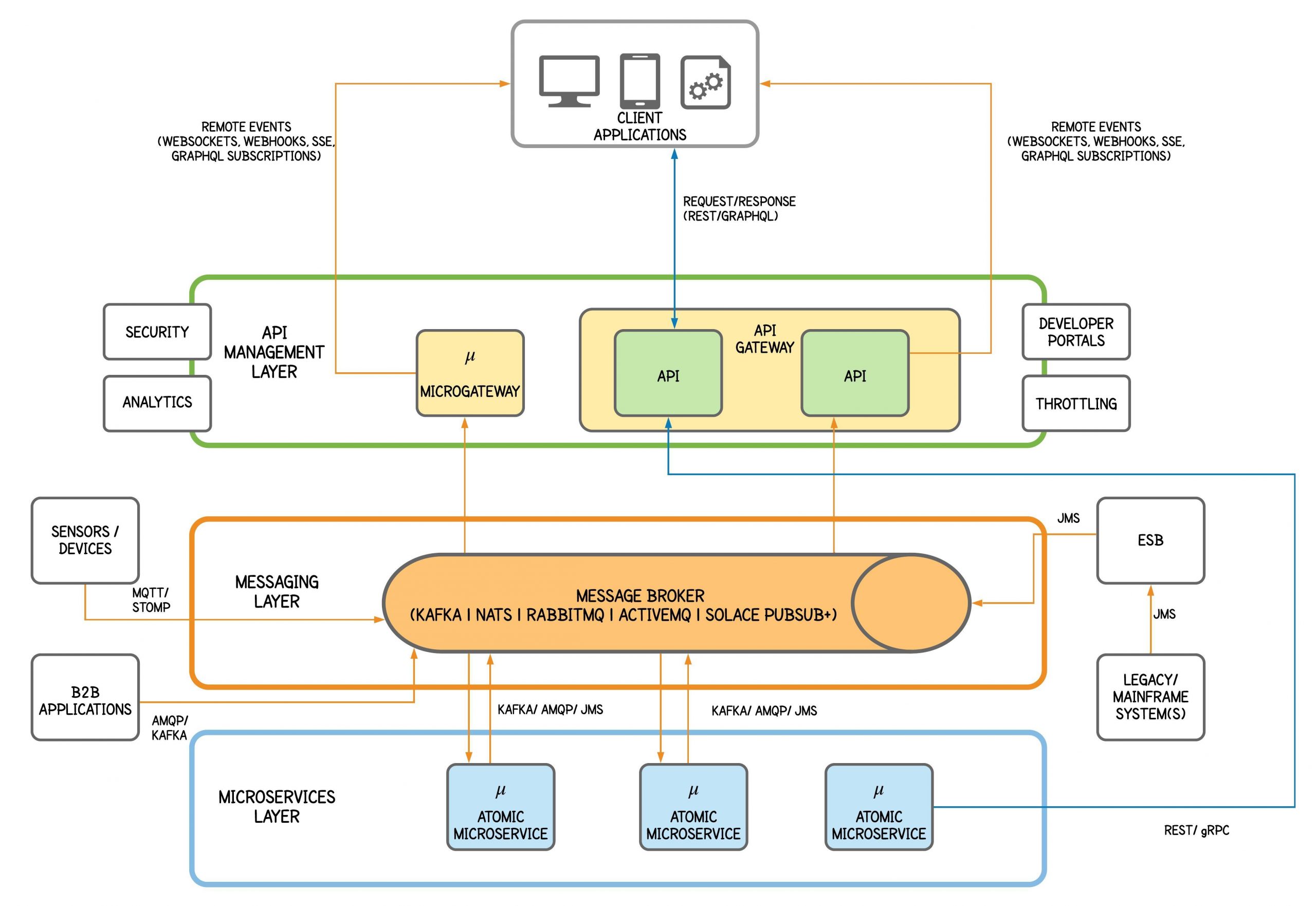
A high-level backend architecture to support event-driven APIs alongside synchronous APIs.
Conclusion
Synchronous APIs are ideal for many scenarios — particularly if you need an instant response.
In other cases, when clients need to be informed of events or the processing required for the response happens at a different time, ordinary synchronous messaging becomes tricky and event-driven APIs can aptly address such needs.
EDA is flexible enough that you can start with simple notifications, or combine two-way event communication with a synchronous approach to delivering an optimal architecture.
So, using an event-driven design alongside a traditional request/response design for your APIs brings the best of both worlds to build highly scalable and reactive web applications.
Furthermore, combining traditional API management capabilities with an event-driven architecture provides tremendous value additions to expand business reach and adoption.
About InApps
As the #1 software development company in Vietnam and #5 in Southeast Asia, we’ve gained valuable insights and experiences to help clients realize their projects.
At InApps technology, one of our core values is to be a business’s best companion. That’s why we keep sharing helpful content like this and listen thoughtfully to our customer’s demands and expectations before starting any project.
If you’re seeking solutions for your software development, you might want to learn more about us. Contact us for free, here!
[sociallocker id=”2721″]
List of Keywords users find our article on Google
event-driven api layer
interactive broker api
outsource event registration services
hasura graphql
instant search react
kafka browser client
facebook app events api
react instant search
react-phone-number-input
event-driven vision
ux design events near me
react select
wso2 api manager
wso2 data analytics server
backend wikipedia
api management wso2
wso2 api manager monitoring
hire remote kafka developers
middleware remote jobs
advantage solutions event specialist part time sales
apis event-driven
outsource custom brokerage software development services
present continuous wikipedia
kafka producer api
hire event driven developer
asyncapi vs openapi
client id kafka producer
hire remote rest api developers
on- and offshore cab
platform events vs change data capture
kafka source connector
api evangelism
client solution architects jobs
kafka cdc connector
hasura
cdc kafka
cdc with kafka
react-select
cdc events kafka
[/sociallocker]
Rate this post
Related Articles
Best Countries to Outsource Software Development (2026 Guide)
Software development outsourcing means hiring an external engineering team - usually based in another country- to design, build, or maintain software on your behalf, instead of hiring in-house. Most US, UK, and Australian companies do this to access skilled engineers faster and at a lower fully-loaded cost than domestic hiring allows.
How to Hire Remote Developers Without Losing Code Quality: A 2026 Playbook for CTOs
Every CTO who hires remote developers eventually asks the same question: how do I know this is going to work before I've sunk three months and a sprint's worth of technical debt into finding out? Most guides to hiring remote developers answer a different question: which platform to use. They skip the part that actually determines whether the code that comes back is any good. This playbook covers the vetting mechanics, engagement models, and real rate data behind hiring remote engineers who ship production-quality code from week one, not another list of freelance marketplaces.
IT Managed Services vs Break-Fix IT Support: What Growing Startups Need in 2026
Break-fix IT feels free right up until the week something breaks in production and there is no one already watching for it. Here is how growing startups actually decide between break-fix support and managed services in 2026, and why the decision has gotten sharper for anyone shipping a product built quickly with AI tools.