
Because there are so many software outsourcing options, they must give their customers the best business software possible. In previous articles, InApps
Because there are so many software outsourcing options, they must give their customers the best business software possible. In previous articles, InApps addressed a wide variety of topics with various forms of software outsourcing. Custom software and commercial off-the-shelf software (COTS software) are two of the most common types, with the most noticeable difference.
The contrast is clearly shown in the different characteristics, and it is also a complementary aspect depending on the software development needs of each organization. For example, when considering enterprise resource management (ERM), it may have many built-in features. Still, it will only be helpful if it fulfills the organization’s business needs that employ it. Let’s look at the differences between commercial off-the-shelf and custom software.
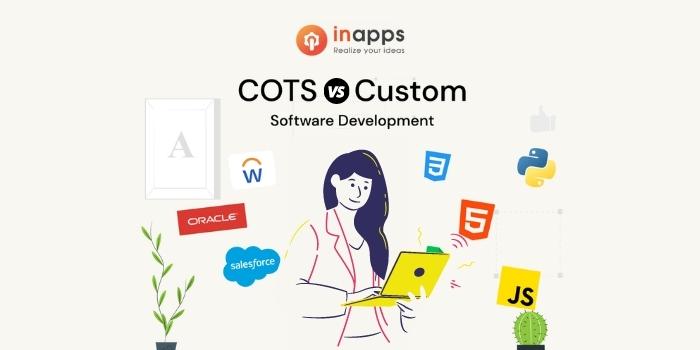
COTS vs custom software development
Key Summary
- Definition: COTS Software: Pre-built, commercially available software designed for a broad user base, ready to use with minimal customization (e.g., Microsoft Office, Salesforce). Custom Software: Tailor-made software developed to meet specific business needs, built from scratch or highly customized for a particular organization.
- COTS Software: Pre-built, commercially available software designed for a broad user base, ready to use with minimal customization (e.g., Microsoft Office, Salesforce).
- Custom Software: Tailor-made software developed to meet specific business needs, built from scratch or highly customized for a particular organization.
- Cost: COTS: Lower initial costs due to mass production; typically involves licensing fees or subscriptions. Custom: Higher upfront development costs but potentially lower long-term costs for specific needs, avoiding recurring fees.
- COTS: Lower initial costs due to mass production; typically involves licensing fees or subscriptions.
- Custom: Higher upfront development costs but potentially lower long-term costs for specific needs, avoiding recurring fees.
- Development Time: COTS: Quick to implement, often available immediately or with minimal setup. Custom: Longer development timeline due to bespoke design, testing, and iteration.
- COTS: Quick to implement, often available immediately or with minimal setup.
- Custom: Longer development timeline due to bespoke design, testing, and iteration.
- Flexibility and Scalability: COTS: Limited customization; may not fully align with unique business processes but offers regular updates and vendor support. Custom: Highly flexible, designed to fit exact requirements, with scalability tailored to the business but reliant on developer support for updates.
- COTS: Limited customization; may not fully align with unique business processes but offers regular updates and vendor support.
- Custom: Highly flexible, designed to fit exact requirements, with scalability tailored to the business but reliant on developer support for updates.
- Maintenance and Support: COTS: Vendor-provided updates, patches, and support; users depend on the vendor’s roadmap. Custom: Requires dedicated maintenance, often by the developing team, offering greater control over updates.
- COTS: Vendor-provided updates, patches, and support; users depend on the vendor’s roadmap.
- Custom: Requires dedicated maintenance, often by the developing team, offering greater control over updates.
- Use Cases: COTS: Ideal for standard processes (e.g., accounting, CRM) or businesses needing quick, cost-effective solutions. Custom: Suited for unique workflows, specialized industries, or businesses with competitive needs requiring proprietary solutions.
- COTS: Ideal for standard processes (e.g., accounting, CRM) or businesses needing quick, cost-effective solutions.
- Custom: Suited for unique workflows, specialized industries, or businesses with competitive needs requiring proprietary solutions.
- Risks: COTS: Risk of dependency on vendor stability and potential feature bloat. Custom: Higher risk of development delays or budget overruns if not managed properly.
- COTS: Risk of dependency on vendor stability and potential feature bloat.
- Custom: Higher risk of development delays or budget overruns if not managed properly.
What is COTS software?
Non-developmental items (NDI) marketed in the commercial marketplace and utilized or purchased through government contracts are commercial off the shelf software (COTS). The Federal Acquisition Regulation defines the set of COTS (FAR) regulations.
A commercial off the shelf software (COTS) product is often a computer hardware or software product that has been modified for specific needs and made available to the general public. Such items are intended to be easily accessible and user-friendly. Microsoft Office or antivirus software are examples of COTS products. A COTS product is any product that is available off the shelf and does not require bespoke development before installation.
Purchasing COTS products has become a need for many large corporations. It is common for a large business to include multiple commercial off-the-shelf (COTS) items into its system for improved functionality and as a relatively risk-free investment. This has resulted in a growing market for commercial off-the-shelf (COTS) items.
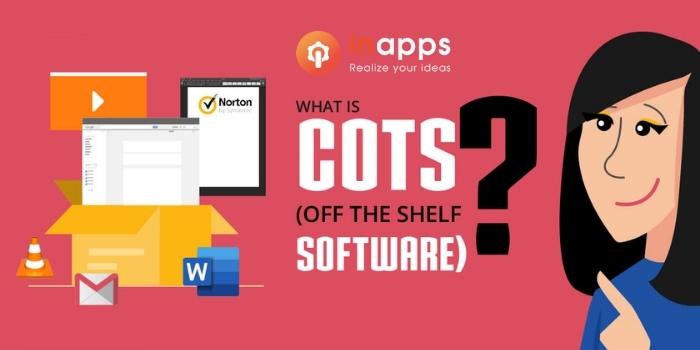
What is COTS software?
What are the Advantages of using COTS Software?
The usage of COTS enables a product developer to benefit from technology breakthroughs, cost reductions, and speedy procurement due to commercial marketplace competitive pressures and innovations in other DoD or government organizations. The usage of these goods can reduce or eliminate the need for costly, time-consuming government-sponsored R&D activities.
Advantages of using Commercial Off The Shelf Software
The following are the advantages of adopting commercial off-the-shelf (COTS) components:
- Cut costs
- Shorten the development time.
- Allow for the speedier incorporation of new technologies.
- Reduce life-cycle costs by utilizing a more readily available and up-to-date commercial, industrial foundation.
COTS vs Custom Software: What is the difference?
Custom software is a designed software solution just for you. They will examine your requirements and provide a specific plan for developing such a product.
On the other hand, commercial off the shelf software has other features, such as being a product that you can buy and use right now. Companies often manufacture this product that adheres to the one-size-fits-all strategy, selling the same set of services to all clients with limited customization. Even though these things are based on general best practices, they may not be appropriate for your requirements.
The following is an easy way to demonstrate the difference between these two concepts:
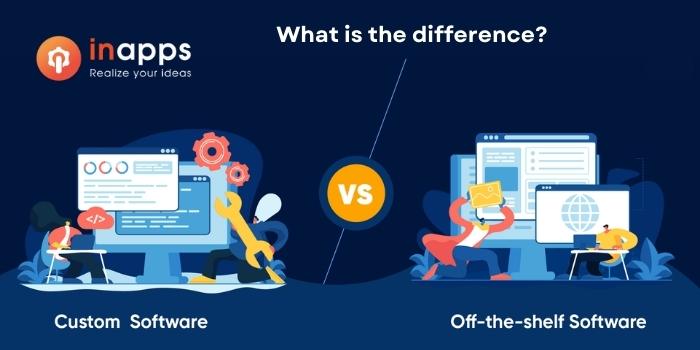
Cots software vs Custom software in comparison
Custom Software Development | COTS Software Development
COTS vs Custom Software: What is better?
What should you choose between COTS software and custom software?
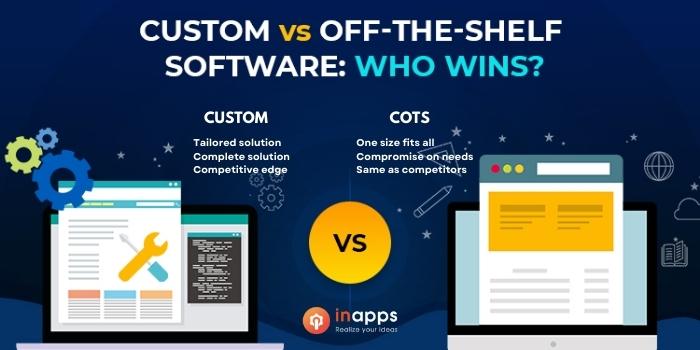
Custom software vs off the shelf software
Fees
When evaluating all of the charges, the total cost of ownership must be included. The initial costs of custom software development may be higher, but the ongoing expenditures will be lower. On the other hand, as a business owner, you don’t have to worry if the product you buy has issues you don’t know who is to blame. The outsourced developers themselves will handle the development issues, saving you a lot of time by not having to deal with problems and upgrades.
On the other hand, COTS software will have cheap starting costs but higher service expenses. As a consequence, you will be required to pay for each month. You’ll have to pay for an upgrade, more customization, or help if you want it.
Time
A custom software development project will take far longer than an off-the-shelf commercial. However, this is not always viewed as a negative, but rather as an opportunity for the outsourcing team better to understand the client company’s business and market characteristics.
Understanding the timing issue, software development firms employ Agile methodologies and MVP demos to speed up the process, which may verify core capabilities and functionality. However, deploying the complete solution might take many months.
Deployment
New apps may be readily added with tailored software without disturbing existing operations or losing crucial data. As your company expands, the software will be simple to adapt and alter. Incorporating commercial off-the-shelf (COTS) software is a little more complicated. If it is not adapted to your needs, your data may be corrupted, or you may incur additional expenditures.
Set of features
The collection of characteristics is a significant distinction between these two notions. You will have greater functionality with bespoke software development since it will be designed with your demands in mind and adapted for every activity.
As a result, COTS software will be severely limited in this area because it was designed for mass-market demand. Buyers don’t have many chances to contact software developers, ask questions, or request that they add more modules or remove something they don’t need.
Additional maintenance
You also get a valuable bonus when you buy anything: a post-purchase warranty. Similarly, when purchasing or contracting a software development project, you must get this correct to ensure that there aren’t too many problems that harm your organization’s primary goal.
You will have access to ongoing support while utilizing the unique software solution. You won’t have to worry about bugs, system outages, or antiquated tools since specialized professionals will always be ready to help you. COTS software often contains a solid support system as long as they have a significant number of clients utilizing their product and need to keep them delighted to maintain their reputation. Not to mention the possibility of upgrades being delayed or even charged.
Final Words
Because we strive for perfection in software outsourcing, we provide extraordinary abilities, talents, and a tried-and-true strategy. We are a seasoned software outsourcing firm with well-established worldwide skills, quality standards, and delivery methodologies that safeguard business values.
High-quality product results from a fantastic team and equally fantastic software development techniques collaborating to create it. Over developers are experts in web and mobile app development, DevOps, database, cloud migration, blockchain, artificial intelligence, etc.
The excellent rating of InApps Technology and selection as a software outsourcing partner by many worldwide clients is not by luck but rather through the quality.
Contact us with your basic details for a free quotation and consultation!
[sociallocker id=”2721″]
List of Keywords users find our article on Google:
cots components
cots software development
cots vs bespoke
cots software vs custom
what is cots
commercial off the shelf software examples
commercial off the shelf software
what is cots software
cots software examples
cots software
cots vs saas
commercial off-the-shelf software
cots vs custom software
cots vs custom
custom and cots applications
wawa menu
what is cots product
what is cots software examples
cots application examples
commercial off the shelf cots software examples
commercial off-the-shelf software examples
custom software development
cots vs custom built software
cots software example
cots stands for
procurement software comparison
cots apps
contact center outsourcing procurement
software development outsourcing
“how to choose software development company”
off the shelf software examples
custom one piece
custom cots
e procurement software comparison
e-procurement software comparison
cheap cots
cots price
erm consultant
cheap software development company indianapolis
“custom software”
“custom software development”
advantages of cots software
custom vs cots
cots software stands for
cots products examples
examples of cots software
erm migration best practices
custom rfi software
bespoke vs cots
buy shelf company in vietnam
saas cots
cots saas
software development firms
advantages of commercial software
eve online biggest corporations
district federal ho chi minh city
hrm contracting and consulting
what is a cots product
commercial off the shelf examples
dod cots policy
teams ndi support
cots payment application systems
custom software vs commercial software
eve c++
cheap cots online
ndi microsoft teams
c++ eve
custom portfolio cases
top 10 software development companies world
it software development company
it application development services procurement
investment operations outsourcing procurement
software engineering outsourcing
software development outsourcing company
custom software
software outsourcing company
software development outsourcing services
enterprise resource management tools
product and software development
fixed price web design
custom software applications development
custom application development company
custom web development services
[/sociallocker]
Rate this post
Read More:
Update How MemSQL Enables Exactly-Once Semantics with Apache Kafka
Related Articles
Best Countries to Outsource Software Development (2026 Guide)
Software development outsourcing means hiring an external engineering team - usually based in another country- to design, build, or maintain software on your behalf, instead of hiring in-house. Most US, UK, and Australian companies do this to access skilled engineers faster and at a lower fully-loaded cost than domestic hiring allows.
How to Hire Remote Developers Without Losing Code Quality: A 2026 Playbook for CTOs
Every CTO who hires remote developers eventually asks the same question: how do I know this is going to work before I've sunk three months and a sprint's worth of technical debt into finding out? Most guides to hiring remote developers answer a different question: which platform to use. They skip the part that actually determines whether the code that comes back is any good. This playbook covers the vetting mechanics, engagement models, and real rate data behind hiring remote engineers who ship production-quality code from week one, not another list of freelance marketplaces.
IT Managed Services vs Break-Fix IT Support: What Growing Startups Need in 2026
Break-fix IT feels free right up until the week something breaks in production and there is no one already watching for it. Here is how growing startups actually decide between break-fix support and managed services in 2026, and why the decision has gotten sharper for anyone shipping a product built quickly with AI tools.