
Many companies are unwilling to take the MVP software development approach because they don't understand it 100%. Considering that MVP is still one of
Many companies are unwilling to take the MVP software development approach because they don’t understand it 100%.
Considering that MVP is still one of the most critical components in creating software. Now let’s talk about what this lean tool means, what mistakes to avoid, and especially how to create an MVP properly.
Key Summary
- Overview: The article by InApps Technology explains the importance of MVP software development, detailing its process, benefits, and strategies for success, emphasizing how it enables startups and businesses to test ideas, reduce risks, and achieve market fit efficiently, particularly with Vietnam’s cost-effective development talent.
- What is an MVP?: A Minimum Viable Product is a basic version of a software product with core features to solve a specific problem, designed to gather user feedback and validate market demand with minimal investment. Focuses on delivering value quickly to test assumptions and iterate based on real-world usage.
- A Minimum Viable Product is a basic version of a software product with core features to solve a specific problem, designed to gather user feedback and validate market demand with minimal investment.
- Focuses on delivering value quickly to test assumptions and iterate based on real-world usage.
- Key Steps in MVP Software Development: Identify Core Problem and Audience: Define the primary problem your product solves and target user group (e.g., small businesses, healthcare providers). Conduct market research to understand user needs and competitors. Define Core Features: Prioritize essential features that address the core problem (e.g., user login, payment processing for an e-commerce app). Avoid feature creep by focusing on simplicity and usability. Choose the Tech Stack: Frontend: React, Flutter, or Angular for responsive, cross-platform interfaces. Backend: Node.js, Python (Django), or Ruby on Rails for rapid API development. Database: MongoDB for flexibility or PostgreSQL for structured data. Cloud: AWS, Azure, or Firebase for scalable hosting. Adopt Agile Development: Use Agile methodologies (e.g., Scrum) with short sprints (1-2 weeks) to build, test, and iterate quickly. Collaborate closely with stakeholders to align on priorities and feedback. Build the MVP: Develop a functional prototype with core features, typically in 2-4 months, depending on complexity. Leverage reusable components and libraries to accelerate development. Test and Validate: Conduct usability, functional, and performance testing (e.g., using Selenium, Postman). Launch a beta version to a small user group to gather feedback via surveys or analytics (e.g., Google Analytics, Mixpanel). Iterate Based on Feedback: Analyze user data to identify pain points, feature requests, or performance issues. Prioritize updates and new features for subsequent iterations to improve product-market fit. Launch and Scale: Release the MVP to a broader audience, optimizing for app stores (ASO) or web visibility (SEO). Scale infrastructure and features as user base grows, using cloud services for elasticity.
- Identify Core Problem and Audience: Define the primary problem your product solves and target user group (e.g., small businesses, healthcare providers). Conduct market research to understand user needs and competitors.
- Define the primary problem your product solves and target user group (e.g., small businesses, healthcare providers).
- Conduct market research to understand user needs and competitors.
- Define Core Features: Prioritize essential features that address the core problem (e.g., user login, payment processing for an e-commerce app). Avoid feature creep by focusing on simplicity and usability.
- Prioritize essential features that address the core problem (e.g., user login, payment processing for an e-commerce app).
- Avoid feature creep by focusing on simplicity and usability.
- Choose the Tech Stack: Frontend: React, Flutter, or Angular for responsive, cross-platform interfaces. Backend: Node.js, Python (Django), or Ruby on Rails for rapid API development. Database: MongoDB for flexibility or PostgreSQL for structured data. Cloud: AWS, Azure, or Firebase for scalable hosting.
- Frontend: React, Flutter, or Angular for responsive, cross-platform interfaces.
- Backend: Node.js, Python (Django), or Ruby on Rails for rapid API development.
- Database: MongoDB for flexibility or PostgreSQL for structured data.
- Cloud: AWS, Azure, or Firebase for scalable hosting.
- Adopt Agile Development: Use Agile methodologies (e.g., Scrum) with short sprints (1-2 weeks) to build, test, and iterate quickly. Collaborate closely with stakeholders to align on priorities and feedback.
- Use Agile methodologies (e.g., Scrum) with short sprints (1-2 weeks) to build, test, and iterate quickly.
- Collaborate closely with stakeholders to align on priorities and feedback.
- Build the MVP: Develop a functional prototype with core features, typically in 2-4 months, depending on complexity. Leverage reusable components and libraries to accelerate development.
- Develop a functional prototype with core features, typically in 2-4 months, depending on complexity.
- Leverage reusable components and libraries to accelerate development.
- Test and Validate: Conduct usability, functional, and performance testing (e.g., using Selenium, Postman). Launch a beta version to a small user group to gather feedback via surveys or analytics (e.g., Google Analytics, Mixpanel).
- Conduct usability, functional, and performance testing (e.g., using Selenium, Postman).
- Launch a beta version to a small user group to gather feedback via surveys or analytics (e.g., Google Analytics, Mixpanel).
- Iterate Based on Feedback: Analyze user data to identify pain points, feature requests, or performance issues. Prioritize updates and new features for subsequent iterations to improve product-market fit.
- Analyze user data to identify pain points, feature requests, or performance issues.
- Prioritize updates and new features for subsequent iterations to improve product-market fit.
- Launch and Scale: Release the MVP to a broader audience, optimizing for app stores (ASO) or web visibility (SEO). Scale infrastructure and features as user base grows, using cloud services for elasticity.
- Release the MVP to a broader audience, optimizing for app stores (ASO) or web visibility (SEO).
- Scale infrastructure and features as user base grows, using cloud services for elasticity.
- Benefits of MVP Development: Cost Efficiency: Minimizes development costs by focusing on essential features; offshore development in Vietnam ($20-$50/hour via InApps Technology) saves 20-40% compared to U.S./EU rates ($80-$150/hour). Risk Reduction: Validates ideas early, reducing the chance of building unwanted products. Faster Time-to-Market: Delivers a working product in weeks or months, enabling early user acquisition. User-Centric: Incorporates real user feedback to ensure the product meets market needs. Investor Appeal: Demonstrates viability to attract funding by showcasing traction and feedback.
- Cost Efficiency: Minimizes development costs by focusing on essential features; offshore development in Vietnam ($20-$50/hour via InApps Technology) saves 20-40% compared to U.S./EU rates ($80-$150/hour).
- Risk Reduction: Validates ideas early, reducing the chance of building unwanted products.
- Faster Time-to-Market: Delivers a working product in weeks or months, enabling early user acquisition.
- User-Centric: Incorporates real user feedback to ensure the product meets market needs.
- Investor Appeal: Demonstrates viability to attract funding by showcasing traction and feedback.
- Challenges: Feature Prioritization: Balancing minimalism with sufficient functionality to engage users. User Adoption: Convincing early users to try a basic product with limited features. Feedback Management: Filtering valuable insights from noise in user feedback. Scalability: Ensuring the MVP’s architecture supports future growth without major rework.
- Feature Prioritization: Balancing minimalism with sufficient functionality to engage users.
- User Adoption: Convincing early users to try a basic product with limited features.
- Feedback Management: Filtering valuable insights from noise in user feedback.
- Scalability: Ensuring the MVP’s architecture supports future growth without major rework.
- InApps Technology’s Role: Expertise: Specializes in MVP development for startups and enterprises, delivering tailored, high-quality solutions. Vietnam Advantage: Leverages Vietnam’s 200,000+ IT professionals, offering affordable rates and strong English proficiency. Services: Provides end-to-end support, from ideation and prototyping to testing, launch, and iteration. Agile Approach: Uses Agile workflows with tools like Jira, Slack, and Zoom for transparent collaboration, accommodating global time zones (GMT+7).
- Expertise: Specializes in MVP development for startups and enterprises, delivering tailored, high-quality solutions.
- Vietnam Advantage: Leverages Vietnam’s 200,000+ IT professionals, offering affordable rates and strong English proficiency.
- Services: Provides end-to-end support, from ideation and prototyping to testing, launch, and iteration.
- Agile Approach: Uses Agile workflows with tools like Jira, Slack, and Zoom for transparent collaboration, accommodating global time zones (GMT+7).
- Use Cases: Startups testing e-commerce, healthcare, or EdTech apps with limited budgets. Enterprises prototyping new features or services before full-scale investment. SMEs building customer-facing apps to enter digital markets quickly.
- Startups testing e-commerce, healthcare, or EdTech apps with limited budgets.
- Enterprises prototyping new features or services before full-scale investment.
- SMEs building customer-facing apps to enter digital markets quickly.
- Recommendations: Start with a clear problem statement and prioritize 2-3 core features for the MVP. Engage users early with beta testing to gather actionable feedback. Use scalable, flexible tech stacks to avoid technical debt in future iterations. Partner with InApps Technology for cost-effective, expert MVP development, leveraging Vietnam’s skilled developers to ensure rapid, successful launches.
- Start with a clear problem statement and prioritize 2-3 core features for the MVP.
- Engage users early with beta testing to gather actionable feedback.
- Use scalable, flexible tech stacks to avoid technical debt in future iterations.
- Partner with InApps Technology for cost-effective, expert MVP development, leveraging Vietnam’s skilled developers to ensure rapid, successful launches.
Read More:
Food Order & Delivery App Development: The Fastest Way To Rule The Market
MVP development meaning
Minimum Viable Product (MVP) has become a trendy word in the tech world.
We have people who focus on the “minimum”; others focus on what is “viable” and the rest believe that MVP is a “product”. Like it or not, one word dropped from a song makes everything wrong.
Here are three things to keep in mind when talking about the Minimum Viable Product:
Notice #1 – MVP involves a limited set of features and functions but ensure the “minimum” doesn’t defeat the “viable”.
As you begin to focus on minimizing your functionality, you may fall into the trap of excluding customer-critical features. As a result, your minimal functionality might not meet your customers’ needs or the business goal of your product.
The Minimum Viable Product is not just about figuring out the minimal features. It’s also about making sure you can help with your customers’ main problem.
Notice #2 – Viable means solving a practical customer problem and delivering validated learning to you.
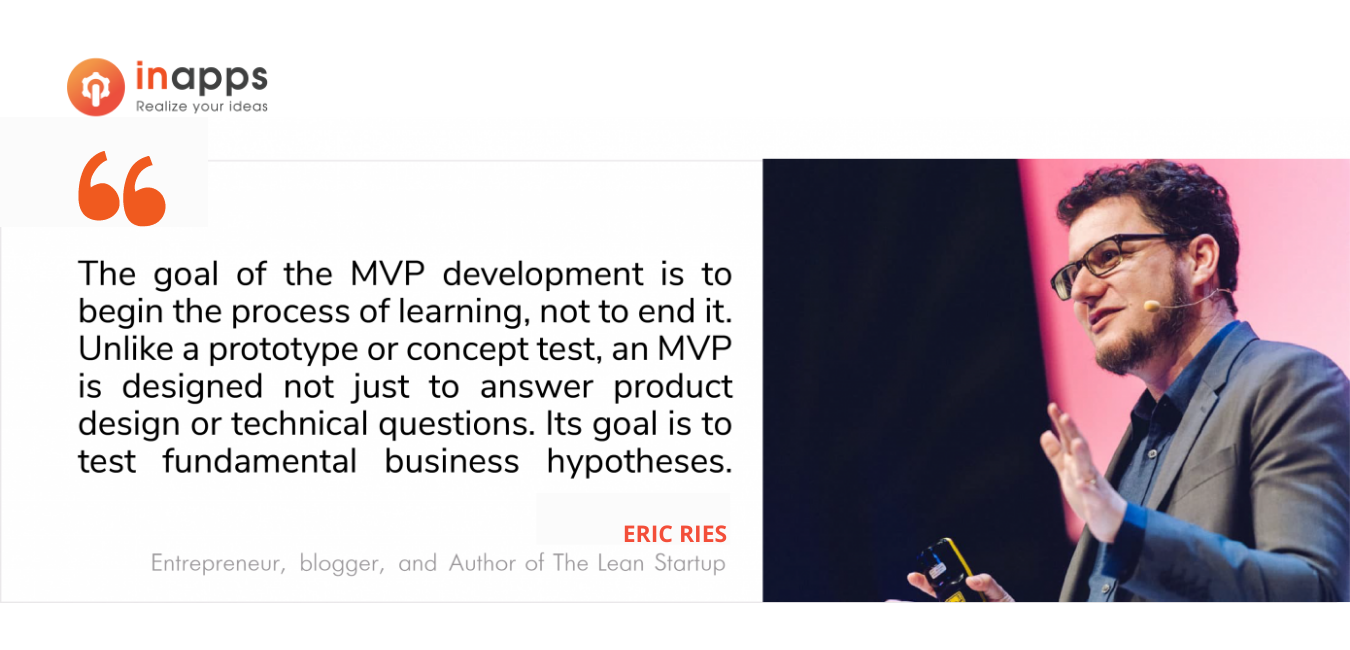
Learning is “a small unit of progress that can be quickly checked to see if a chosen direction is right” (according to “The Lean Startup” by Eric Ries).
Developing a product quickly from a half-cooked and premature prototype can not get them anywhere. Fast, shoddy product development should never be called an MVP.
Notice #3 – MVP is never an end product as it aims to start the learning process.
Entrepreneurs develop an MVP to test assumptions in their business model, get feedback, make necessary improvements, and create a new MVP iteration to test the following hypothesis.
We call it the Build-Measure-Learn feedback loop, which is at the heart of creating great software products. In this way, creating a minimum viable product is an iterative process.
05 signs that your MVP software development is on the wrong way
With these tips and an understanding of what MVP means in business, let’s move on to the five common mistakes entrepreneurs make when developing their Minimum Viable Product.
Sign #1: Focusing on a large target audience
Don’t try to reach everyone with your Minimum Viable Product development. You have a much higher chance of success if you know precisely your MVP aims to whom.
Try to please a limited audience rather than doing something for everyone. Imagine that someone invites you to a workshop, and the organizer tells you that the workshop is for “who has invitation” only. It sounds good.
If you haven’t determined your niche audience, you risk spending big bucks on marketing with no returns or quality feedback on your product. Winning the hearts of a small targeted audience can help you establish a stable position in the market early on.
Sign #2: Waiting for a full-featured complete product
Supposedly, you exactly know what your potential users want. In actual market conditions, one cannot be 100% sure. You can only guess.
So make your Minimum Viable Product a simple and valuable tool for your target audience, and they will tell you what they like best or dislike to build a complete product.
Read More:
Top Android Frameworks and Libraries for App Development in 2022
Sign #3: Thinking that UX is not the part of an MVP
But on the contrary! UX (User experience) and UI (User interface) are the building blocks of a successful product.
According to Forrester, better and more seamless UX design can improve customer conversion rates by 400%.
Ultimately, the MVP design should be handy and straightforward, following fundamental unity, balance, hierarchy, proportion, emphasis, and contrast.
When the design meets the above requirements, it is easier for the end-user to understand and use. An excellent first impression is a foundation for building trust, which is vital as there is usually no second chance to correct a bad impression.
Sign #4: Too many features in your first version
Too many features are not good in this case. An incomplete set of functionality is not a good thing as well.
As reported by CB Insights, one of the main reasons for product failure is poor usability. As a result, additional functions do not improve your minimum viable product. But complicate it.
After testing your assumptions with your MVP software development and knowing what your users want, you can add functionality.
It’s hard to believe, but nearly 65% of software product features are rarely or never used. What functions do you use in Microsoft Word or Microsoft Excel, for example? Maybe, about 30% if you are a power user!
Hence, when you build an MVP app, focus only on the crucial moments. You can save a lot of time and money while reducing time to step on the market.
Sign #5: Not learning from your MVP
Treat your Minimum Viable Product like an experiment. Every comment, good or bad, is equally important. It will help you better understand your first users and improve the product to meet customer needs.
Ultimately, it would be best to focus on finding the middle ground between your product’s capabilities and the needs of your end-users. Now you are aware of the mistakes you should avoid. It’s time to review the correct path to creating a Minimum Viable Product.
The formula for MVP software development process
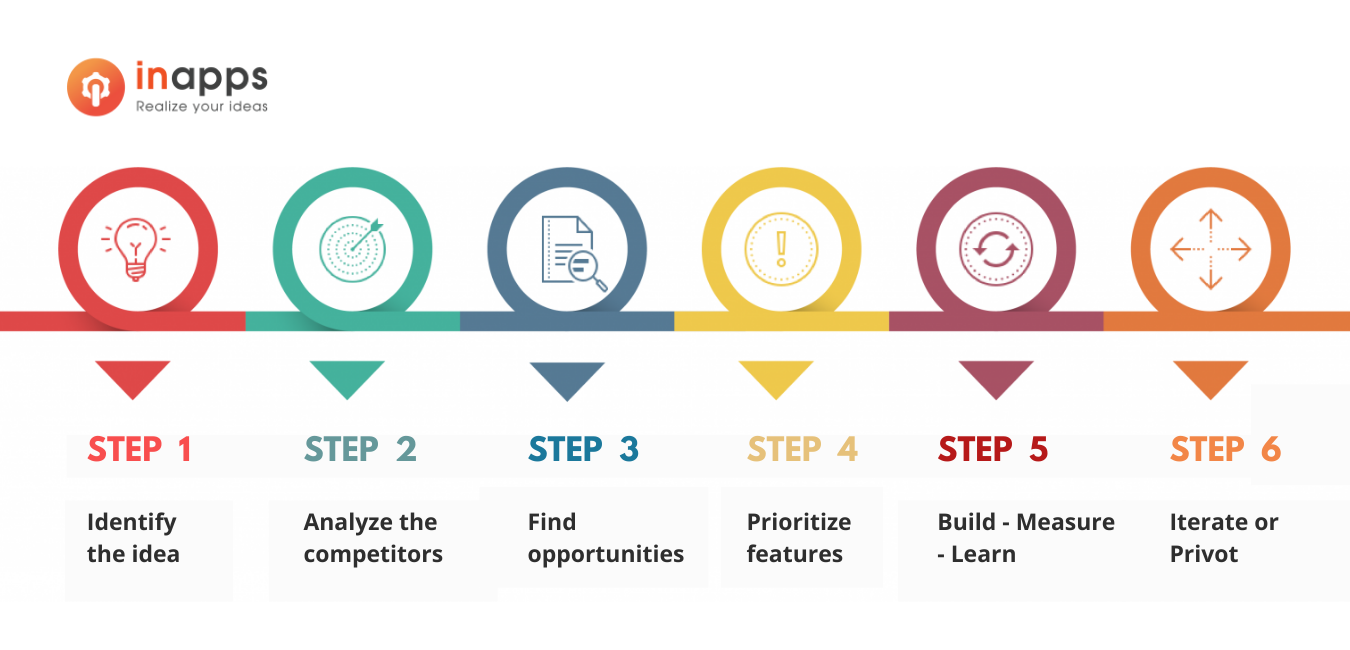
Step #1: Identify the idea/ problem
Put yourself in your customer’s shoes to find out the answer to these questions: “Why do I need this product?” and “What can I do with this product that I couldn’t do before?”.
It happens that entrepreneurs become obsessed with an idea and completely forget about the problem they are trying to solve.
Therefore, you need to start with: Why your product needs to exist and determine the criteria that will show whether your product is successful (more than one metric).
Step #2: Analyze the competitors
Once the idea is established, it is vital to check whether related products are on the market. Neglecting competitor analysis and blindly trusting the uniqueness of your product can pose an ominous threat to project success. If you feel you have no direct competitors, your unconditional belief in the uniqueness of the product is not a reasonable reason to market it.
Competitor analysis is essential in any case. You have to know your industry like the back of your hand. You can use tools like Google Trends, SimilarWeb, Compete, and others to look for new “players” or see if something changes with the permanent leader.
Feel free to adopt some good ideas from your competitors and also learn from their mistakes.
Step #3: List down needed features
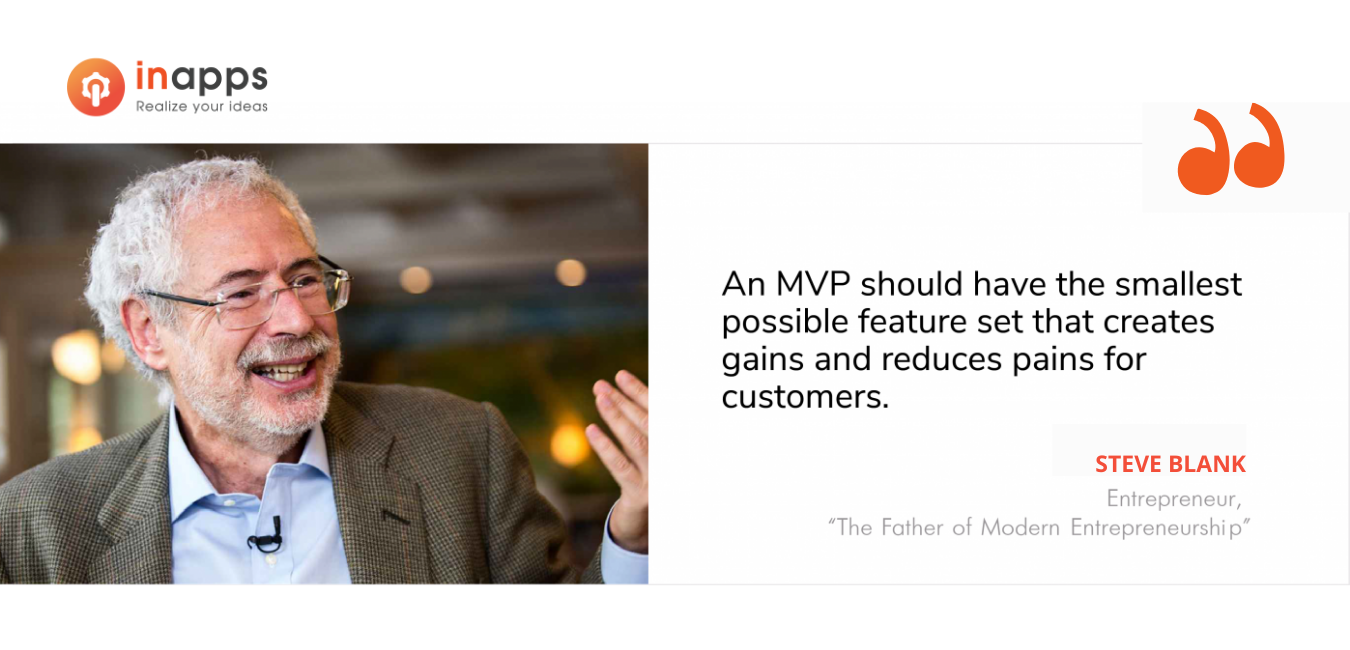
You should publish the simplest version of the product that has enough functionality to test fundamental questions such as:
- Is there a real problem?
- Does the problem matter to people?
- Can the solution solve this problem?
With your MVP, focus on solving your target audience’s weaknesses. You can use a “How could we” opportunity statement for this purpose. For example, “How could we make it easier for users to book appointments?” etc. It helps you turn the pain points into features description.
Read More:
What You Need To Know About Desktop Application Development
Step #4: Prioritize features
Once the features are listed, you will need to identify the keys for your first version. The prioritization matrix, for example, is a relatively simple tool that you can use to order a variety of characteristics according to importance.
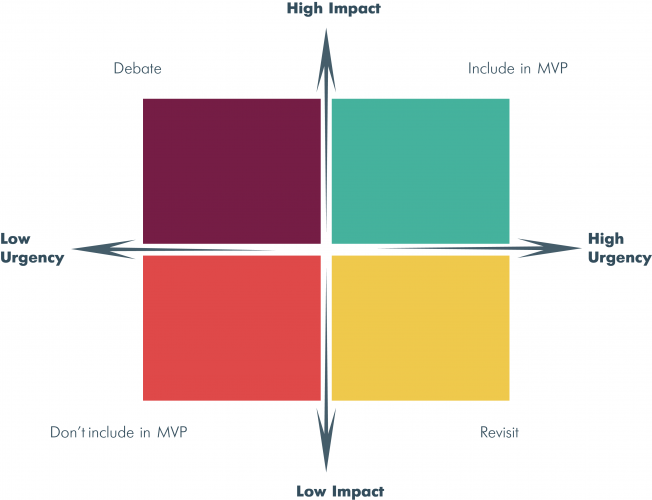
Another “tool” that can help you prioritize is the MoSCoW method, which divides its functions into “Must Have”, “Should Have”, “Could Have”, and “Will Not Have”.
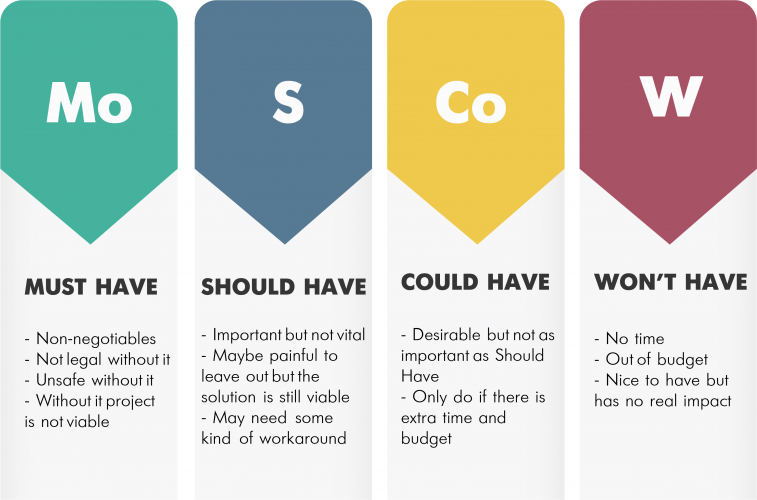
MoSCow matrix helps you check the entire business idea, its properties, and functionality and “work out” the most important product properties for the market launch. The goal of the prioritization step is to decide what to include in your MVP and what to reserve for future releases.
Step #5: Build-Measure-Learn Phase
When your MVP features are mapped out and prioritized – start the development.
But remember that MVP is just a stepping stone and the beginning of a feedback loop, allowing you to improve your product in 3 stages continuously: Build, Measure, and Learn.
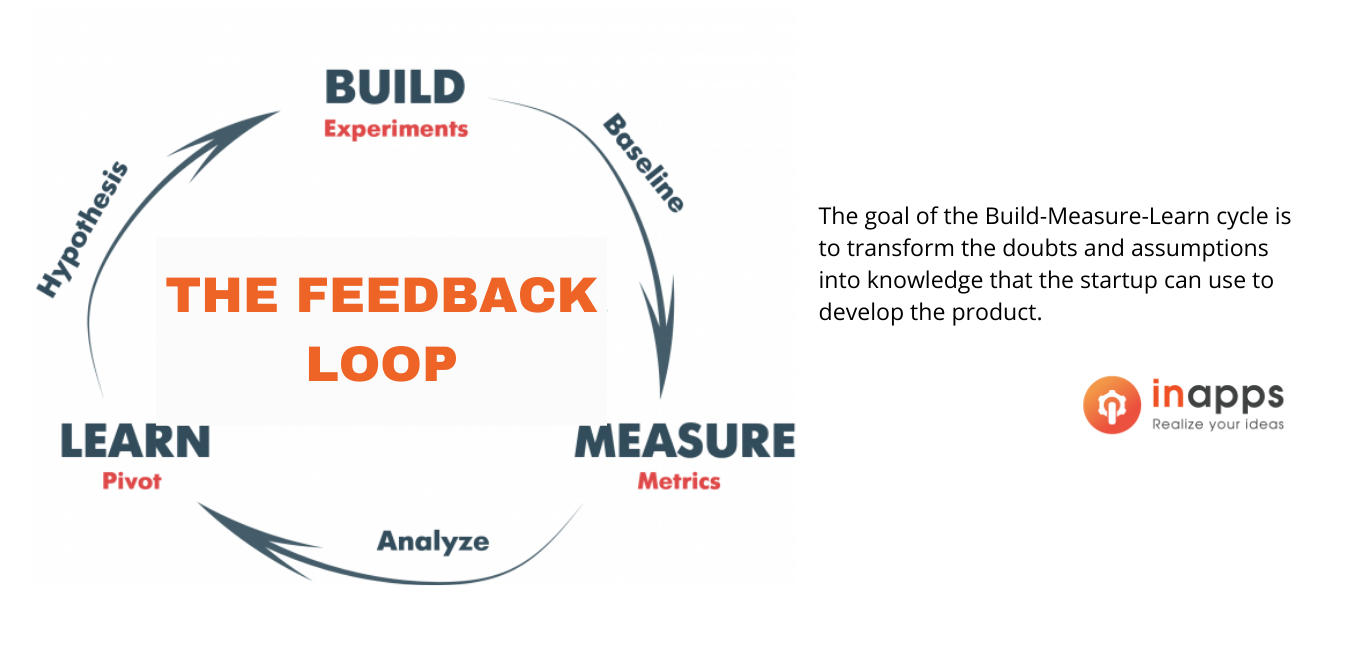
Let’s take a look at the components:
- Phase 1 – Build: This phase aims to build or develop the MVP to test some assumptions or build the hypothesis.
- Phase 2 – Measure: In the second phase, the startup defines whether or not real progress is being made. It includes the measurement of the results of the BUILD phase experiment.
- Phase 3 – Learning: The startup decides whether to hold out or turn around.
This means that the company keeps the existing strategy and goals or changes the entire strategy of the product or its aspects. The feedback loop enables you to turn the idea into a product and measure the customer’s reaction. And decide whether to pivot or persevere.
Step #6: Iterate or Pivot
Sometimes user feedback can confirm your beliefs and show that you are on the right track. Sometimes it can show that you’ve made a slip and are going in the wrong direction. All of these signs are critical to developing an MVP app that people need.
- It is essential to listen to your users.
- You are creating a product that will benefit your life.
- Asking users what they want is helpful.
Conclusion
An MVP aims to solve fundamental user problems by identifying weaknesses and focusing on a workable solution. Keep this information in view every step of the way in creating a Minimum Viable Product.
I hope these tips have been helpful, and you are now entirely armed to give the correct answer, what is MVP in software, and begin your journey into a successful software solution.
MVP development service
MVP (Minimum Viable Product) is the best way to reduce the risks and convert challenges to opportunities. After identifying your app idea journey and considering your budget, you had better go with an offshore development company.
Why don’t you join an IT Tech company like InApps that had experience and a professional process to transform an idea into a unicorn? You can benefit from our outsourcing software development services and offshore development team at the same time. We always offer end-to-end services with:
- Transparent cost and commitment.
- Free consultation and completed proposal.
- Free design mobile application concept.
Owning a Tech Talent Hub with 5–10 year-experienced developers and engineers, InApps Technology is proud to give clients 100% satisfaction and trust in their projects.
- We offer MVP development packages only from $20.000.
- Customize the solution depends on a thorough understanding of your business model.
- Commit to sending you a completed proposal within 48 hours.
- Commit to delivering within 2 months.
Reliability is one of the elements to make the best decision! Hence, we shall show you our reputation via our case studies.
[sociallocker id=”2721″]
List of Keywords users find our article on Google:
mvp meaning software
mvp software development
mvp meaning in software development
mvp in software development
mvp software development company
mvp meaning in software
mvp software development services
mvp software design
mvp for software development
mvp development services
mvp development meaning
mvp software
mvp formula
mvp prioritization matrix
minimum viable product development services
minimum viable product template excel
what is mvp in software development
matrix mvp
minimum viable software development agency
mvp development company
mvp template excel
mvp meaning software development
mvp software meaning
minimum viable software development consultant
what is mvp in software
software engineering mvp
what does mvp mean in software development
mvp full form in software
mvp in software means
mvp meaning in programming
saas mvp development company
minimum viable product template word
inview eric ries
[/sociallocker]
Rate this post
Related Articles
Best Countries to Outsource Software Development (2026 Guide)
Software development outsourcing means hiring an external engineering team - usually based in another country- to design, build, or maintain software on your behalf, instead of hiring in-house. Most US, UK, and Australian companies do this to access skilled engineers faster and at a lower fully-loaded cost than domestic hiring allows.
How to Hire Remote Developers Without Losing Code Quality: A 2026 Playbook for CTOs
Every CTO who hires remote developers eventually asks the same question: how do I know this is going to work before I've sunk three months and a sprint's worth of technical debt into finding out? Most guides to hiring remote developers answer a different question: which platform to use. They skip the part that actually determines whether the code that comes back is any good. This playbook covers the vetting mechanics, engagement models, and real rate data behind hiring remote engineers who ship production-quality code from week one, not another list of freelance marketplaces.
IT Managed Services vs Break-Fix IT Support: What Growing Startups Need in 2026
Break-fix IT feels free right up until the week something breaks in production and there is no one already watching for it. Here is how growing startups actually decide between break-fix support and managed services in 2026, and why the decision has gotten sharper for anyone shipping a product built quickly with AI tools.