





ODC pipeline failures are architectural, not geographical – 73% of first-audit engagements reveal the same five structural gaps regardless of region, timezone, or team size.
Most Offshore Development Center (ODC) integrations degrade pipeline velocity not because of geography, but due to five preventable architecture gaps that compound silently.
Drawing from InApps’s infrastructure audit data across 250+ distributed engagements in Fintech, Healthtech, and SaaS – conducted between 2019 and 2025 using a standardized five-pillar DevOps Maturity Assessment – we’ve diagnosed and resolved, these failure patterns firsthand across tech stacks. Whether you are mid-launch or evaluating What is an Offshore Development Center?, these architectural decisions determine if your pipeline scales with your team or bottlenecks against it
Why Does Distributed Engineering Require a Structural Pipeline Shift?
Adding an offshore team should compound velocity. However, a pipeline built for a single timezone fails under distributed demands. The root cause is structural the lack of deliberate cross-regional engineering governance.
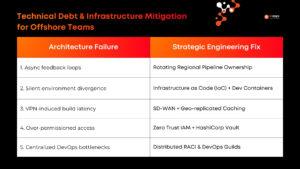
1. How Do Async Feedback Loops Across Timezones Stall Your Pipeline?
A CI failure at the end of a HQ workday blocks the pipeline for 10–12 hours in a standard ODC setup. Across 500 weekly builds, that translates to 40–60 hours of monthly blocked capacity, a recurring cost that rarely appears in original project estimates.
The structural problem isn’t the timezone. It’s the absence of a formalized handoff model. When pipeline health is implicitly owned by HQ, offshore engineers have no clear authority, or escalation path, to act independently on incidents during their shift.
The Fix: Follow-the-Sun Pipeline Ownership
Each region holds explicit on-call health responsibility during their working hours. Shift transitions are formalized: a 15-minute structured handoff via incident management tooling captures pipeline status, open alerts, and active blockers.
The Result: A Series B SaaS platform in the HR tech space – 90-person engineering team split across Vietnam (UTC+7) and the US East Coast (UTC-5) – reduced overnight Mean Time to Resolution (MTTR) from 8.3 hours to under 35 minutes by formalizing a 15-minute shift handoff via PagerDuty.
Key Tools: GitHub Actions (region-aware), PagerDuty. See: Observable CI/CD Pipelines for DevOps Success.
Data note: MTTR figures drawn from PagerDuty incident logs and sprint retrospective data collected during InApps infrastructure audits. Baseline and post-implementation periods each cover a minimum of 60 calendar days.
2. What Is the Impact of Configuration Drift on Distributed Team Reliability?
Minor version mismatches, Node.js 18.16 vs. 18.19, Python 3.10.4 vs. 3.10.9, create flaky tests that pass locally and fail in CI. In a co-located team, someone notices and patches it within the hour. In a distributed team, the mismatch surfaces during a sprint cycle, gets misdiagnosed as a code bug, and consumes senior engineer time before the environment root cause is identified.
Across InApps audits, teams operating without declarative environment definitions spend an average of 11% of senior engineer time on environment-related debugging, time that is structurally invisible in sprint velocity metrics but measurable in sprint completion rates.
The Fix: Infrastructure as Code + Dev Containers
Define environments declaratively using HashiCorp Terraform or Docker Dev Containers . Environment parity becomes a structural guarantee enforced at the IaC layer, not a documentation task that relies on individual engineers reading README files.
The principle: if it cannot be version-controlled, it cannot be consistently reproduced across regions.
Data note: 11% senior engineer time figure is based on time-tracking data from sprint retrospectives across 47 InApps engagements where environment parity was flagged as a recurring issue. Self-reported via team leads during DevOps Maturity Assessment interviews; cross-referenced against CI failure logs.
At InApps, we treat environment parity as a structural guarantee enforced at the IaC layer, not a “best effort” documentation task. Our audits show that teams without declarative environments spend an average of 11% of senior engineer time on environment-related debugging.
3. How Does VPN Architecture Create Hidden CI/CD Latency at Scale?
A centralized VPN routes every dependency pull, artifact fetch, and registry call through a single geographic chokepoint. For a team of 15 engineers running builds 20 times daily, routing through a US-based VPN from Vietnam adds 15–18 seconds per dependency layer pull. Aggregated, this wastes approximately 4.5 hours of compute time per team, per day, not counting the developer wait time while watching progress bars.
At scale, this becomes a budget problem. Cloud compute time billed against idle wait is pure overhead. It also masks pipeline performance: teams attribute slow builds to “offshore infrastructure” rather than the actual cause.
The Fix: Three-Pillar Network Architecture
- SD-WAN for intelligent routing (replaces static VPN tunnels)
- Geo-replicated caching (JFrog Artifactory or AWS CodeArtifact)
- Mirrored container registries(AWS ECR or Google Artifact Registry).
The Result: A 60-person engineering team at a Series A e-commerce company (Fintech vertical, Vietnam + Singapore, UTC+7/UTC+8 split) saw offshore build times drop from 23 minutes to 11 minutes – a 52% reduction – within two weeks of implementing regional mirroring.
Data note: Build time figures measured from CI run logs (GitHub Actions) before and after regional mirroring implementation. Pre-implementation baseline: 30-day average. Post-implementation measurement: 14-day average, allowing for cache warm-up period.
4. Why Does Over-Permissioned Access Become a Compliance Risk in ODCs?
Rapid onboarding in ODC environments creates a predictable pattern: a developer needs elevated access to unblock a task, a ticket is raised, admin rights are granted “temporarily,” and the access is never revoked. Across a 12-month engagement with regular team rotation, this privilege creep accumulates into a significant compliance exposure.
Verizon 2024 Data Breach Investigations Report (DBIR) found that 68% of breaches involve a non-malicious human element, misconfigured access and accidental exposure rank prominently. In ODC contexts, this risk is amplified by the volume of onboarding cycles relative to a co-located team.
The Fix: Zero Trust IAM + Dynamic Credentials
Replace persistent credentials with short-lived, dynamically generated access using HashiCorp Vault or AWS Secrets Manager t. Access auto-revokes. No ticket required to clean up.
The compliance benefit compounds: SOC 2 Type II and ISO 27001 Annex A controls around access management become a byproduct of the architecture rather than a manual audit exercise. Auditors verify the system, not the ticket trail.
- Hardcoded secret scanning at the pre-commit stage
- Identity-based access policies rather than IP allowlisting
- Quarterly access review automation via Vault’s audit log API
5. Why Does Centralized DevOps Control Block Offshore Pipeline Autonomy?
If offshore engineers cannot resolve incidents without a ticket to a central HQ, MTTR skyrockets – a pattern we observed in 73% of first-audit ODC engagements at InApps.
The Fix: Decentralize ownership via Backstage.io (Developer Portal) and a clear Distributed RACI matrix. Empower regional engineers with the authority to investigate and approve recovery during their shift.
The Result: Engineering teams that shift to this model consistently see off-hours incident resolution times drop by 60-75%.
Strategic Prioritization: How Should a CTO Sequence These Fixes?

To re-architect velocity, sequence your remediation based on Risk vs. Speed-to-Impact:
- Identity Governance (Immediate Risk Mitigation): Contain “Privilege Creep.” Highest compounding risk. Prioritize this failure to eliminate invisible liabilities.
- Regional Ownership (The Low-CapEx Quick Win): Focus on MTTR. Requires zero infrastructure spend – only a shift in Operational Design.
- Environment Parity via IaC (The Foundation): Stop senior talent from “debugging ghosts” by stabilizing the deployment environment.
Network & Distributed DevOps (Scaling the Gains): Once stable, optimize network topology and decentralize DevOps to decouple delivery teams from central bottlenecks.
Why Do Engineering Leaders Choose InApps for ODC CI/CD Integration?
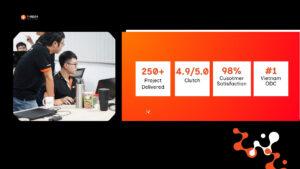
250+ Projects | 4.9/5 Willing to Refer | 98% Customer Satisfaction | #1 in Vietnam on Clutch
Every InApps ODC engagement begins with the five-pillar DevOps Maturity Assessment outlined in this article. Unlike staff augmentation models, the architects who design the pipeline are the same engineers who operate it in production and own the post-launch outcomes.
The Outcome: An ODC that ships faster in month three than month one – because the pipeline was built to scale, not patched after growth exposed its limits.
Explore InApps ODC Integration Services | Talk to an Engineer
FAQ: Frequently Asked Questions about ODC CI/CD Pipelines
Why do CI/CD configuration errors impact ODCs more severely than in-house teams?
- Answer: In an ODC (Offshore Development Center) model, the primary “silent killer” is the Asynchronous Feedback Loop. A minor pipeline failure at the end of a HQ business day can stall an offshore team for an entire 8-10 hour shift due to timezone gaps. At InApps, we mitigate this by implementing Self-Healing Pipelines and Automated Rollbacks, ensuring that distributed teams aren’t paralyzed by infrastructure bottlenecks while HQ is offline.
How do you maintain CI/CD pipeline security when sharing source code with an offshore partner?
- Answer: Zero Trust Architecture: short-lived dynamic credentials via HashiCorp Vault or AWS Secrets Manager, hardcoded secret scanning at pre-commit, and identity-based access policies rather than IP allowlisting. IP allowlisting fails the moment an engineer works from a different location. Identity-based access fails gracefully and leaves an audit trail. Relevant compliance frameworks: SOC 2 Type II CC6.1 and ISO 27001 Annex A 8.2.
What are the most critical metrics for measuring CI/CD health in an ODC setup?
- Answer: DORA metrics, specifically MTTR (Mean Time to Recovery) and Change Failure Rate, are the leading indicators. MTTR surfaces whether your offshore team can resolve incidents independently. Change Failure Rate surfaces whether your review and testing architecture is sound. Build volume is a vanity metric in this context; high build volume with high change failure rate is worse than low build volume with low failure rate.
Is it better to use a shared CI/CD infrastructure or separate environments for ODCs?
- Answer: Unified infrastructure governed by IaC is superior. Separate environments create the configuration drift problem described in Failure #2 – environments diverge, and the divergence is invisible until it breaks something in staging or production. The safeguard is not separation; it is automated environment conformance testing and guardrails that prevent manual configuration changes outside the IaC layer.
How does InApps optimize CI/CD costs for ODC clients?
Answer: Three levers: (1) AI-driven test orchestration to skip redundant test suites, reducing build minutes by up to 40%; (2) Cloud Spot Instances for non-critical CI workloads; (3) automated shutdown of idle staging environments outside business hours. Combined, these typically reduce monthly cloud CI overhead by 25–30% without affecting deployment velocity. Figures based on InApps billing analysis across 18 clients where cost optimization was a defined engagement objective (2023–2025).
Published: March 19, 2026 | Last reviewed: March 19, 2026 | By: InApps AI-Powered Engineering Strategy Team
Let’s create the next big thing together!
Coming together is a beginning. Keeping together is progress. Working together is success.